Affiliate disclosure: Some links below are affiliate links. If you buy through one, Dog Product Reviews earns a commission at no extra cost to you. As an Amazon Associate I earn from qualifying purchases. Full disclosure.
A documented back-plus-chest-attachment Amazon route.
Evidence: research-led
Main drawback: It is not German Shepherd-specific. The Amazon search can mix models, sizes, colours and sellers, so confirm Front Range and the measured band before buying.
Skip if: The measured girth does not fit the current Ruffwear chart, or a trial fit rides up, rotates, rubs, changes movement or allows slipping.
There is no universal German Shepherd harness size. The Royal Kennel Club describes an ideal deep chest with long, well-formed ribs and explicitly warns that an individual dog can be larger or smaller than the breed-standard measurements. Those body words explain why strap position deserves attention; they do not select Medium, Large, XL or any numbered size.
This page now owns one purchase decision: matching an everyday walking harness to the individual German Shepherd and the exact current maker chart. It does not turn breed, sex, weight, height or puppy age into a size, and it does not promise to stop pulling, prevent escape, protect joints or treat a medical condition.
The shortlist deliberately compares three different routes. Ruffwear Front Range is a back-plus-chest-attachment Amazon option; Julius-K9 IDC Powerharness is a back-attachment-and-handle Amazon option; PerfectFit German Shepherd is a modular neck-buckle route bought directly from its maker. The first two Amazon routes can earn DPR a commission; the PerfectFit route does not.
Quick answer:
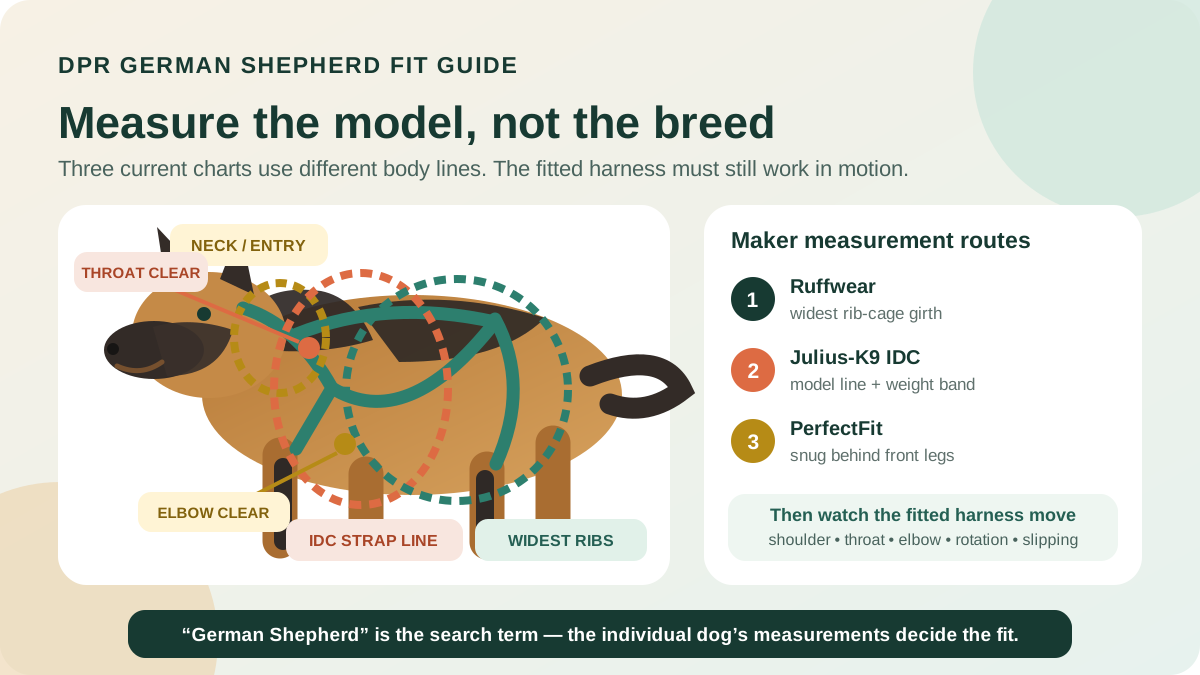
Measure for the exact model. Ruffwear uses the widest rib cage; Julius-K9 defines a size-specific line behind the front legs and also publishes weight bands; PerfectFit asks for a snug girth immediately behind the front legs.
Best-documented dual-attachment Amazon route: Ruffwear Front Range. It publishes four adjustments, a back aluminium V-ring, reinforced chest webbing and five widest-rib-cage bands from 33–107 cm.
Handle-led Amazon route: Julius-K9 IDC Powerharness. The standard model publishes a top handle, back attachment and nine chest-plus-weight bands. Its optional front accessory is not included in this comparison.
Modular direct route: PerfectFit German Shepherd Harness. It publishes five adjustments, replaceable pieces, a neck buckle and maker fitting support. Its displayed preset is not “the German Shepherd size”.
Fit still decides. Check shoulder, throat and armpit clearance, movement, rotation and reverse-out risk before relying on any route.
German Shepherd harness comparison: three different fit routes
These are current maker-published specifications, not German Shepherd fit, comfort, control or durability findings from Dog Product Reviews. Reopen the exact chart and stock selector before ordering.
Replaceable modular pieces; five adjustments; neck buckle; top and front D-rings; maker-stated 30°C machine wash.
Measure snugly just behind the front legs, then use the finder or sizing team. The rendered 64–74 cm preset is only a starting route.
Direct non-affiliate route. PerfectFit says it is not an anti-pull device and its front D-ring must never be used alone.
What actually matters here
Open the exact maker page before measuring; “widest rib cage” and a model-specific line behind the front legs are not interchangeable.
Reject a breed, sex, height, age or weight recommendation that skips a required current measurement.
Check shoulder, throat and armpit clearance, then confirm the harness stays centred and cannot be slipped while the dog moves.
Choose an over-head or neck-buckle entry according to the individual dog’s handling response.
Choose attachment hardware for the walking job; a chest point, back ring or handle is not a training, comfort or safety result.
Confirm the exact model, measured band, seller, stock, components and unused-return terms before paying or removing tags.
Who this is for
German Shepherd owners comparing dual-attachment, handle-led and modular everyday walking routes.
Growing dogs or adults whose girth, entry response or body proportions make a breed label unreliable.
Owners prepared to measure the individual dog and inspect the fitted harness while it walks, turns, sits and lowers its head.
Who should skip
You want a breed label to choose the size without measuring, checking the exact chart and trial-fitting the individual dog.
Repeated backing out is the main risk; compare a secure-body design and individual backup plan rather than assuming an everyday harness is escape-proof.
You need vehicle restraint, mobility support, working-dog equipment or a pulling-sport harness; those are different product jobs.
The dog has pain, stiffness, limping, a changed gait or reluctance to exercise; seek veterinary advice instead of treating equipment as a diagnosis or remedy.
Why “German Shepherd” is not a harness size
The Royal Kennel Club German Shepherd standard describes an ideal powerful, well-muscled dog with a strong neck, a chest around 45–48% of height, and long ribs that are neither barrel-shaped nor too flat. Those are conformation terms, not retail measurements.
The same standard says the listed ideal size does not imply that an individual dog matches it. Do not convert German Shepherd, male, female, puppy age, height or kilograms into Size 1, Size 2, Large or L/XL.
This page stays distinct from the main harness guide by applying three current maker systems to German Shepherd questions. The measurement guide owns the wider cross-brand method, while the no-pull guide compares pulling-management products.
Ruffwear Front Range: the dual-attachment Amazon route
Ruffwear currently publishes four adjustment points, an aluminium back V-ring and reinforced chest webbing. Its chart uses widest-rib-cage girth across XXS 33–43 cm, XS 43–56 cm, S 56–69 cm, M 69–81 cm and L/XL 81–107 cm.
Ruffwear says to choose the larger band when a measurement sits between bands. That is model-specific guidance, not permission to assume Medium or L/XL from breed, sex, weight, height or age.
The Amazon button opens an exact-name search, not a fixed offer or an assurance of stock. Confirm Front Range, then verify the seller, measured size, colour and returns route. DPR has not used retailer ratings as evidence.
Julius-K9 IDC: the back-attachment-and-handle route
Julius-K9’s current IDC page documents a standard back attachment and top handle. The chest steering accessory shown elsewhere is optional and is not part of the standard product compared here.
The current official chart publishes nine bands from Baby1 29–36 cm to Size 4 96–138 cm, each with a weight range. Its UK breed table lists several possible German Shepherd bands but expressly calls breed suggestions a guide and requires a chest measurement.
The IDC fitting guide places the measuring line a model-specific distance behind the front legs and tells owners to check chest-strap and belly-strap position. Wrong size or adjustment can create contact, chafing or a route to back out, so chart selection is not the end of the fit check.
The exact-name Amazon search is size-neutral. Confirm IDC Powerharness, then match the current chest and weight band, seller, components and return terms. Julius-K9 notes that some current units can differ from older product images as parts are updated.
PerfectFit German Shepherd: the modular neck-buckle route
PerfectFit’s German Shepherd route publishes five adjustment points, replaceable modular pieces, a neck buckle, top/front D-rings and a maker-described Y-shaped front. It asks for a snug rib-cage girth immediately behind the front legs.
The rendered 20 mm L-M-L preset and 64–74 cm adjustment range are a starting configuration, not “the German Shepherd size”. PerfectFit directs growing, mixed, between-size and unusually shaped dogs to its sizing team with measurements and photographs.
PerfectFit says the harness is not an anti-pull device. Its current FAQ says the front D-ring must never be used alone: use a double-ended lead connected to front and back if following that setup.
The PerfectFit button goes directly to the manufacturer and earns Dog Product Reviews no commission. Maker comfort, movement and security language remains manufacturer information rather than a DPR finding.
Fit-check a deep chest while the dog moves
Dogs Trust advises avoiding harnesses that cross directly in front of the shoulders and prevent natural movement, allowing one finger comfortably beneath the straps, ensuring the harness stays positioned during movement and confirming the dog cannot slip out.
Check while the German Shepherd stands, walks, turns, sits and lowers its head. Look for the chest section rising towards the throat, contact behind the elbows, rubbing or hair change, persistent rotation, shortened stride, distress or the beginning of a reverse-out.
Keep tags and the receipt while checking indoors, then recheck after growth, body-condition or coat change, strap adjustment, washing, a wet walk or visible wear. Stop using a harness that cannot stay clear and stable.
A chest attachment manages direction; it does not train
Ruffwear describes its chest webbing as a way to redirect a pulling dog. PerfectFit describes its front D-ring as steering support when used with the back ring. Julius-K9’s standard IDC route uses a back attachment. Those facts describe hardware; they do not prove a pulling reduction or training result on an individual German Shepherd.
Follow the exact maker rule. PerfectFit prohibits front-only use, Ruffwear documents a different chest-webbing setup, and the standard IDC does not include a chest point. Do not transfer instructions between products.
Entry style, handle and puppy growth are separate decisions
Ruffwear Front Range and Julius-K9 IDC use an over-head entry. PerfectFit clips around the neck. Dogs Trust says a neck-and-body clipping design may suit a head-shy dog; introduce any format gradually and step back if the dog retreats or shows distress.
A top handle can help with close guidance only within the maker’s instructions. It is not proof that a harness can safely lift, support mobility or restrain a dog in a vehicle. If physical support is required, ask a vet or rehabilitation professional about equipment designed for that job.
A puppy can move between chart bands quickly, but there is no reliable age-to-size schedule. Measure before each purchase and again whenever strap limits, body condition, coat or harness position change. Do not leave extra looseness as “growing room”; the current fit still has to remain positioned and resist slipping.
Escape security and car restraint are different products
An everyday harness is not automatically escape-proof. If a dog can reverse a shoulder through the opening or has escaped before, use the secure-fit harness guide and an individual backup plan rather than overtightening an ordinary harness.
A walking ring or handle is also not crash-test evidence. PerfectFit explicitly says its harness has not been crash tested and does not recommend it for car use. Use the dog car-harness evidence guide for vehicle restraint and follow the exact car and product instructions.
Hip, elbow and gait concerns belong with a vet
PDSA’s German Shepherd guidance lists hip dysplasia, elbow dysplasia and degenerative myelopathy among conditions that may affect the breed. A walking harness cannot prevent, diagnose or treat those conditions.
Pain, stiffness, limping, weakness, a changed gait, difficulty with stairs or reluctance to exercise needs veterinary advice. Stop relying on equipment that appears to change movement or cause distress; do not treat a different clip position, thicker pad or handle as medical support.
Questions German Shepherd owners are asking now
Recent owner discussions ask what to do when adjustable straps still leave a loose neck or arm opening, a puppy grows quickly, the harness rubs behind the elbows, the dog backs out, over-head entry causes avoidance, or a front attachment is expected to replace loose-lead training.
There is no reliable breed-wide size. Ruffwear asks for widest-rib-cage girth; Julius-K9 uses an IDC-specific chest line plus weight; PerfectFit asks for snug girth just behind the front legs. Use the exact current chart and check the fitted harness in motion instead of ordering Large, XL, Size 1 or Size 2 from breed, sex, weight, height or age.
Is Ruffwear Front Range the best harness for every German Shepherd?
No. It is the featured Amazon route because Ruffwear publishes clear adjustment, attachment and girth information. DPR has not fitted it on a German Shepherd, and the individual dog’s measurements, entry response and finished moving fit decide suitability.
A documented back-plus-chest-attachment Amazon route
It is not German Shepherd-specific. The Amazon search can mix models, sizes, colours and sellers, so confirm Front Range and the measured band before buying.
The standard setup has no chest steering point and the optional front accessory is not included. The Amazon search mixes sizes and colours, so match both current chart inputs and inspect the finished fit.
A modular fit, neck-buckle entry and direct maker sizing support
Selection can be more involved. PerfectFit says the harness is not an anti-pull device and its front D-ring must be paired with the back ring using a double-ended lead.
££
Recommended picks
Best-documented dual-attachment Amazon route
Best for: A documented back-plus-chest-attachment Amazon route
Ruffwear Front Range Dog Harness
Why it made the list:Ruffwear’s current page publishes four adjustment points, an aluminium back V-ring, reinforced chest webbing and five widest-rib-cage bands from 33–107 cm. It is selected for transparent current specifications, not a DPR German Shepherd fit, pulling or durability result.
Main drawback: It is not German Shepherd-specific. The Amazon search can mix models, sizes, colours and sellers, so confirm Front Range and the measured band before buying.
Pros
Five published widest-rib-cage bands from 33–107 cm.
Back and chest attachment points are documented.
Four adjustment points and explicit care instructions.
Cons
No German Shepherd fit, pressure, pulling, escape or durability test by DPR.
No handle or breed-wide size recommendation.
Amazon model, stock, seller and measured variant require checking.
Julius-K9 IDC Powerharness — a standard back attachment and top handle
PerfectFit German Shepherd Harness — a modular fit, neck-buckle entry and direct maker sizing support
Best for: A standard back attachment and top handle
Julius-K9 IDC Powerharness
Why it made the list:Julius-K9’s current guide publishes a standard back attachment, top handle and nine size bands that combine chest circumference with weight. The separate fitting guide defines the strap line and adjustment checks for the exact IDC design.
Main drawback: The standard setup has no chest steering point and the optional front accessory is not included. The Amazon search mixes sizes and colours, so match both current chart inputs and inspect the finished fit.
Pros
Top handle and standard back attachment are documented.
Nine published chest-and-weight bands.
Model-specific measuring, fitting and care instructions.
Cons
No chest steering point in the standard setup.
No independent German Shepherd comfort, movement, escape or wear result.
Components, Amazon seller, size and colour require checking.
PerfectFit German Shepherd Harness — a modular fit, neck-buckle entry and direct maker sizing support
Ruffwear Front Range Dog Harness — a documented back-plus-chest-attachment Amazon route
Best for: A modular fit, neck-buckle entry and direct maker sizing support
PerfectFit German Shepherd Harness££
Why it made the list:PerfectFit’s current German Shepherd page publishes five adjustment points, replaceable modular pieces, a neck buckle that avoids over-head fitting and top/front D-rings. Its rendered preset starts a fitting route; it does not prove a universal German Shepherd size.
Main drawback: Selection can be more involved. PerfectFit says the harness is not an anti-pull device and its front D-ring must be paired with the back ring using a double-ended lead.
Relative budget: ££. Check the retailer for the current price.
Pros
Five maker-published adjustment points.
Neck buckle avoids over-head entry.
Replaceable pieces and sizing-team support.
Cons
No independent German Shepherd fit, comfort, pulling or wear result.
Front D-ring cannot be used as a single attachment.
There is no reliable breed-wide size. Ruffwear asks for widest-rib-cage girth; Julius-K9 uses an IDC-specific chest line plus weight; PerfectFit asks for snug girth just behind the front legs. Use the exact current chart and check the fitted harness in motion instead of ordering Large, XL, Size 1 or Size 2 from breed, sex, weight, height or age.
Is Ruffwear Front Range the best harness for every German Shepherd?
No. It is the featured Amazon route because Ruffwear publishes clear adjustment, attachment and girth information. DPR has not fitted it on a German Shepherd, and the individual dog’s measurements, entry response and finished moving fit decide suitability.
Should I choose Ruffwear, Julius-K9 or PerfectFit?
Choose Ruffwear when its widest-rib-cage chart fits and you need documented back and chest attachments. Consider the standard Julius-K9 IDC when a top handle and back attachment are the priority, or PerfectFit for modular pieces, neck-buckle entry and maker sizing support. None has been independently fitted or performance-tested here.
What size harness should I buy for a German Shepherd puppy?
Do not use an age-to-size shortcut. Measure immediately before buying and recheck whenever the harness changes position or nears its adjustment limit. Do not leave extra looseness as growing room; the harness still needs to stay positioned and prevent slipping today.
Does a front clip stop a German Shepherd pulling?
No attachment point replaces training. Ruffwear describes chest webbing as redirection; PerfectFit permits its front D-ring only with the back ring and a double-ended lead. Use the exact maker instructions and reward-based loose-lead training.
Is Julius-K9 IDC escape-proof?
No escape-proof result is claimed here. Julius-K9 warns that wrong size, adjustment or lead use can allow a dog to back out. A dog with a previous escape needs a separate secure-fit assessment and backup plan.
Can a German Shepherd wear an everyday harness in the car?
A walking attachment or handle is not proof of crash testing. PerfectFit says its harness is not crash tested and does not recommend it for the car. Use a vehicle-restraint product with evidence for that exact job and follow the car and restraint instructions.
What if the harness rubs or changes my German Shepherd’s gait?
Stop relying on it as fitted. Recheck the maker’s measurement line and adjustment order, inspect strap position while the dog moves and contact the maker or a qualified fitter. Persistent rubbing, skin change, pain, stiffness, limping, weakness or altered gait needs veterinary advice.
Useful measuring and handling accessories
Optional extras that may help with the task on this page. Check size, compatibility and care instructions before buying; these are category searches, not products tested by Dog Product Reviews.
Soft body-measuring tape
Record every maker-defined measurement before buying and recheck after puppy growth, body-condition or coat changes.