Best Dog Puzzle Toys UK 2026: 3 Research-Led Picks
Three UK dog puzzle toys compared by current difficulty, play format, cleaning and safety instructions. Research-led, with no invented testing or fixed session promises.
Affiliate disclosure: Some links below are affiliate links. If you buy through one, Dog Product Reviews earns a commission at no extra cost to you. As an Amazon Associate I earn from qualifying purchases. Full disclosure.
Evidence: research-led. Dog Product Reviews has not used, timed, cleaned or wear-tested these exact toys. We checked current Outward Hound specifications and safety instructions for the Dog Tornado, Dog Brick and Hide A Squirrel, then applied current Blue Cross guidance on supervision, damage checks and counting food towards the dog’s normal ration. How we assess products.
Adjustable Level 2 food puzzle with current documented parts.
Evidence: research-led
Main drawback: It must be hand-washed with mild soap and warm water, dried fully and stored after supervised use. The maker says not to let a dog chew the game or its pieces.
Skip if: Dogs likely to chew or swallow plastic, fabric, squeakers or removable pieces.
Puzzle feeders and hide-and-seek toys can give a dog another way to sniff, paw, lift or slide for a reward. They are one enrichment format, not a timed substitute for walks, training, rest or individual welfare needs.
This shortlist keeps three current Outward Hound products because the maker publishes the mechanism, difficulty and safety instructions for each. The Dog Tornado and Dog Brick are food puzzles; Hide A Squirrel is a supervised plush game and should not be treated as the same buying decision.
The Blue Cross food-toy guide advises supervising puzzle-feeder use, checking toys for damage and using part of the dog’s normal meal where appropriate so enrichment food does not silently increase the daily ration.
Quick answer:
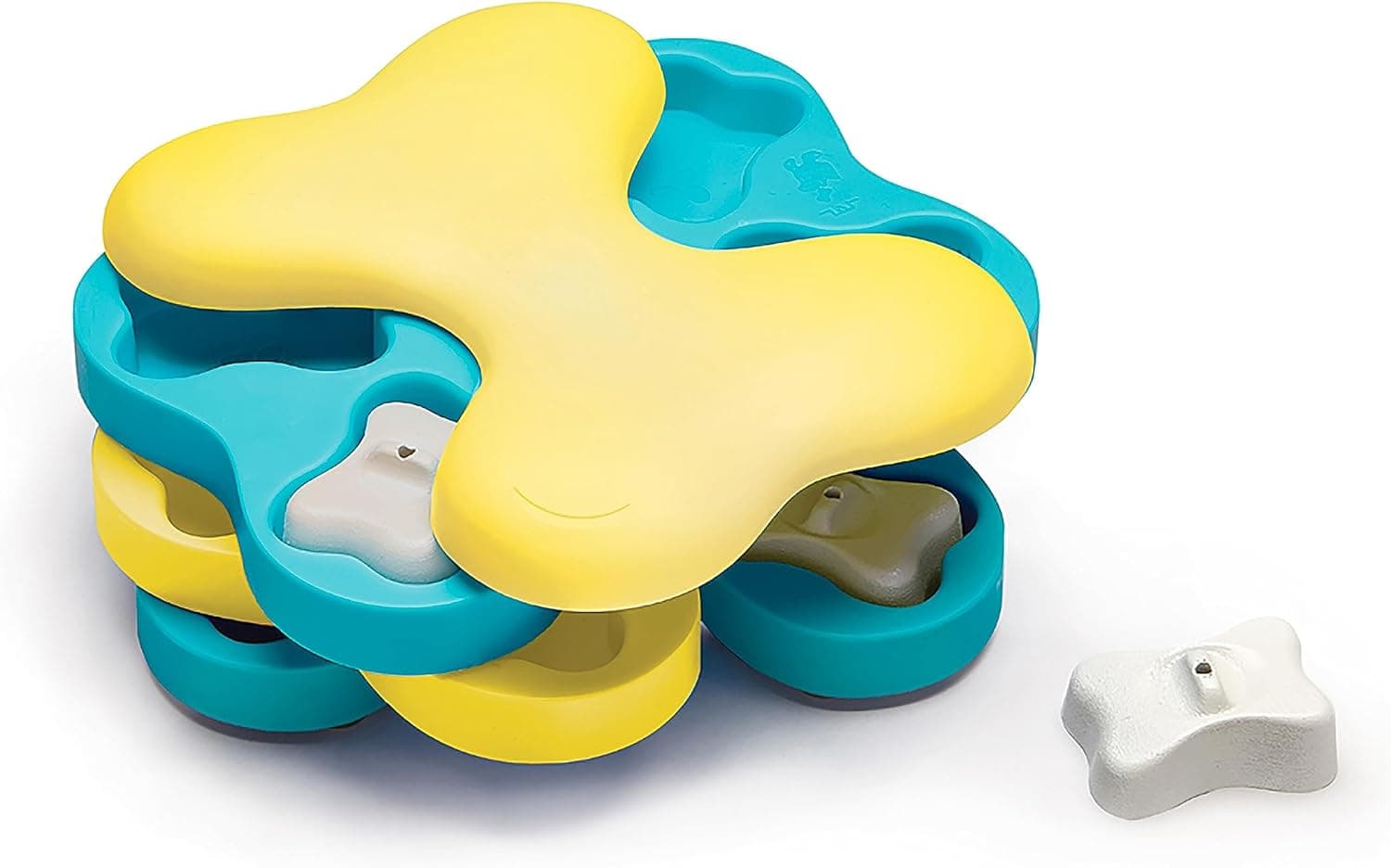
Best-documented adjustable Level 2 option: Nina Ottosson Dog Tornado — three rotating tiers, 12 food compartments and three removable bone covers.
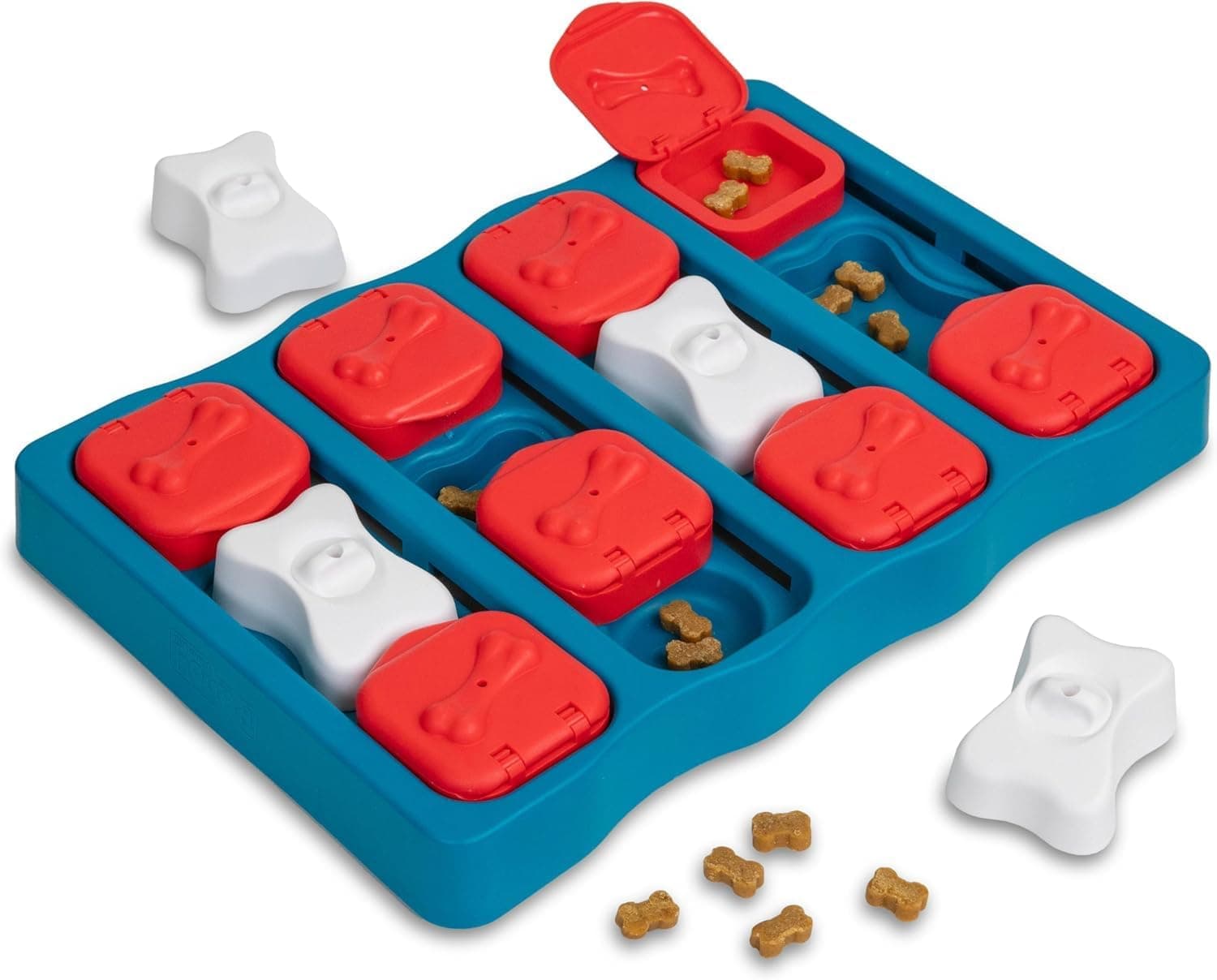
Best for progressing from Level 1: Nina Ottosson Dog Brick — a Level 2 game using flip, lift and slide actions across three hiding formats.
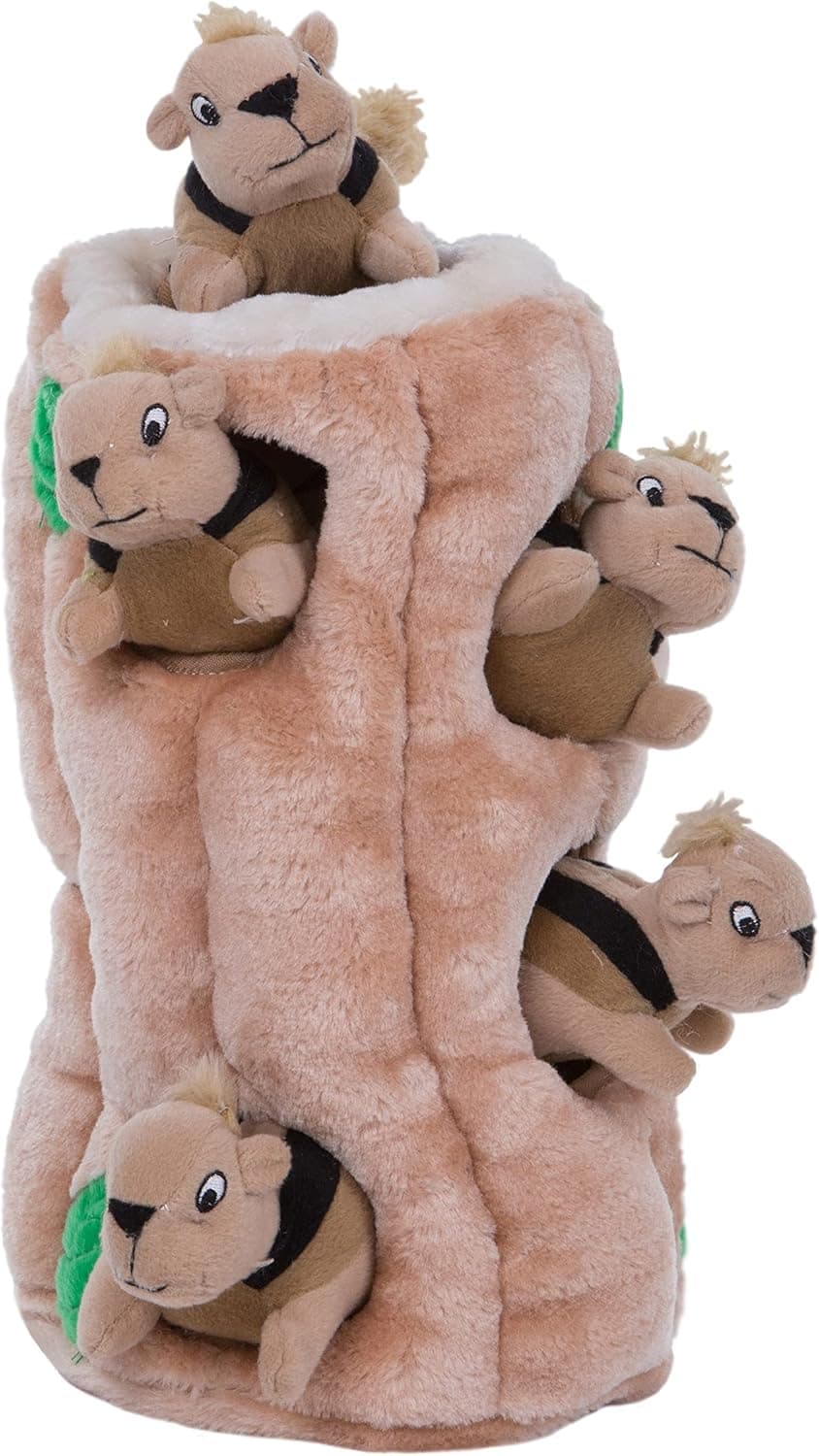
Best non-food format: Outward Hound Hide A Squirrel — a supervised plush hide-and-seek toy; choose the size and included pieces from the exact current variant.
What actually matters here
A current manufacturer page that identifies the exact play actions, difficulty level and care method.
A starting level the individual dog can understand; Level 2 is not a universal beginner setting.
Close supervision, appropriate size and removable parts that can be checked before and after use.
A care routine that follows the exact label: Dog Tornado and Dog Brick are hand-wash products.
Food taken from the normal daily ration where suitable, rather than an uncounted stream of extra treats.
Who this is for
Owners who can supervise a dog using a food puzzle or plush hide-and-seek toy.
Dogs that enjoy sniffing, pawing, lifting or sliding to find food or toys.
Owners willing to start with an easy setup and demonstrate a new action.
Who should skip
Dogs likely to chew or swallow plastic, fabric, squeakers or removable pieces.
Any situation where the toy would be left with the dog unsupervised.
Dogs on a restricted diet unless the food allowance has been agreed and counted.
Start at a level the dog can solve
Outward Hound’s own safety instructions say to teach the dog how the game works. On the first attempt, expose some food and demonstrate the relevant spin, slide or lift action instead of loading every obstacle and walking away.
There is no defensible fixed three-day progression. Make one element harder only after the dog is using the current setup without chewing parts, abandoning the game or showing escalating frustration.
What the maker’s Levels 1–4 mean
Outward Hound’s difficulty guide describes Level 1 as one-step play, Level 2 as new actions such as lifting, tipping or sliding, Level 3 as two-step solutions and Level 4 as its multi-action expert format.
The scale describes the maker’s mechanisms, not a dog’s intelligence. Paw-led and nose-led dogs may find different actions easier, and a dog new to this format may need a Level 1 game even if it learns quickly elsewhere.
Supervision, cleaning and food allowance
Both plastic puzzles must be hand-washed with mild soap and warm water, then dried fully. Inspect every part before and after use, remove a damaged toy and store the empty puzzle out of reach.
Blue Cross recommends close supervision and suggests using part of the dog’s normal daily meal in enrichment food toys where appropriate. That avoids turning a useful activity into an uncounted source of extra calories.
One enrichment format, not a replacement for the rest of the day
A puzzle can offer another opportunity to sniff, forage or solve a simple action. It does not have a universal time-equivalence with walking and it does not replace exercise, training, social contact, rest or veterinary and behavioural support where those are needed.
Quick questions before you buy
Are puzzle toys suitable for puppies?
There is no universal 12-week rule. Choose an age- and size-appropriate product, begin with a simple action, supervise continuously and remove any toy the puppy tries to chew or dismantle.
Is Level 2 the right starting point for every dog?
No. Outward Hound positions Level 1 as its one-step starting format and says the Dog Brick suits dogs that have already mastered Level 1. Start with the actions the individual dog can understand.
Adjustable Level 2 food puzzle with current documented parts
It must be hand-washed with mild soap and warm water, dried fully and stored after supervised use. The maker says not to let a dog chew the game or its pieces.
The bone pieces are removable and the maker requires close supervision, damage checks and storage when empty. It is hand wash only, not dishwasher safe.
Supervised plush hide-and-seek rather than a food puzzle
This is not a chew toy or a food puzzle. The maker requires an appropriate size, supervision, regular inspection and removal if fabric, squeakers or other parts become damaged or separated.
£
Recommended picks
Best-documented adjustable food puzzle
Best for: Adjustable Level 2 food puzzle with current documented parts
Nina Ottosson Dog Tornado£
Why it made the list: The current Dog Tornado page identifies a Level 2 game with three rotating tiers, 12 compartments and three bone covers that can increase the difficulty. Those are maker specifications, not results from a DPR play test.
Main drawback: It must be hand-washed with mild soap and warm water, dried fully and stored after supervised use. The maker says not to let a dog chew the game or its pieces.
Typical price band: £
Pros
Three rotating tiers.
12 published food compartments.
Three covers provide a documented way to vary the setup.
Cons
Hand wash only.
Not a chew toy.
Supervision and a damage check are required every time.
Nina Ottosson Dog Brick — dogs ready to progress from a Level 1 food puzzle
Outward Hound Hide-A-Squirrel — supervised plush hide-and-seek rather than a food puzzle
Best for: Dogs ready to progress from a Level 1 food puzzle
Nina Ottosson Dog Brick£
Why it made the list: Outward Hound describes the current Dog Brick as a Level 2 puzzle for dogs that have mastered Level 1. It uses flip lids, sliding compartments and removable bone covers across three hiding formats.
Main drawback: The bone pieces are removable and the maker requires close supervision, damage checks and storage when empty. It is hand wash only, not dishwasher safe.
Typical price band: £
Pros
Flip, lift and slide actions.
Three documented types of hiding place.
Level 2 progression is explicit on the maker page.
Outward Hound Hide-A-Squirrel — supervised plush hide-and-seek rather than a food puzzle
Nina Ottosson Dog Tornado — adjustable Level 2 food puzzle with current documented parts
Best for: Supervised plush hide-and-seek rather than a food puzzle
Outward Hound Hide-A-Squirrel£
Why it made the list: The current Hide A range is a reusable plush hide-and-seek format. Available sizes and included pieces vary, so the buyer must check the exact Amazon variant instead of relying on a universal squirrel count.
Main drawback: This is not a chew toy or a food puzzle. The maker requires an appropriate size, supervision, regular inspection and removal if fabric, squeakers or other parts become damaged or separated.
A different food-spreading format with its own material, care and supervision checks.
FAQ
Are puzzle toys suitable for puppies?
There is no universal 12-week rule. Choose an age- and size-appropriate product, begin with a simple action, supervise continuously and remove any toy the puppy tries to chew or dismantle.
Is Level 2 the right starting point for every dog?
No. Outward Hound positions Level 1 as its one-step starting format and says the Dog Brick suits dogs that have already mastered Level 1. Start with the actions the individual dog can understand.
How long should a puzzle session last?
There is no evidence-based fixed target for every dog. End the session if the dog starts chewing pieces, becomes frustrated, loses interest or needs a rest, and store the toy when empty.
Can I use meal kibble instead of treats?
Blue Cross suggests using part of the dog’s normal daily meal in enrichment food toys where suitable. Account for every food item in the daily ration and follow veterinary diet advice.
Are the Dog Tornado and Dog Brick dishwasher safe?
No. The current manufacturer instructions say to hand wash both with mild soap and warm water and make sure all compartments are dry before reuse.
What to buy alongside
Optional extras that may help with the task on this page. Check size, compatibility and care instructions before buying; these are category searches, not products tested by Dog Product Reviews.
Size-matched stuffable rubber toy
A refillable food toy offers a different licking and chewing action. Choose the exact size and follow the maker’s supervision and damage instructions.