Four exact UK dog ball launchers compared by ball size, manual or automatic format, storage, settings, supervision and current Amazon product identity.
Affiliate disclosure: Some links below are affiliate links. If you buy through one, Dog Product Reviews earns a commission at no extra cost to you. As an Amazon Associate I earn from qualifying purchases. Full disclosure.
Evidence: research-led. Dog Product Reviews has not thrown, folded, noise-tested, jam-tested, weather-tested or durability-tested these exact launchers, and has not observed a dog using them. We checked current Petmate/Chuckit and PetSafe specifications, UK welfare guidance and each exact Amazon model and availability on 31 July 2026. Manufacturer distance and performance statements remain attributed; DPR did not measure them. How we assess products.
A simple manual launcher using medium Chuckit! balls.
Evidence: research-led
Main drawback: “18M” is a product-size code, not a promise that this is the right ball for every medium or large dog. DPR has not measured throw distance, release consistency, pickup force, comfort or durability.
Skip if: Still-growing, elderly, injured, arthritic, overweight or joint-risk dogs until a vet has advised on suitable exercise.
A manual ball thrower, folding thrower and automatic launcher are not interchangeable. Start with a ball that is too large for the individual dog to fit wholly in the mouth, then choose the launch format and space rather than buying the longest or most powerful option first.
The former guide promised manual and automatic choices but linked two manual Chuckit launchers and a 4-inch treat-dispensing puzzle ball. That third product is not a launcher, so it has been removed from this buying route.
PDSA says repeated chasing, sprinting and sudden stops can stress joints and muscles, and some dogs keep fetching when tired or too hot. A launcher changes the throw; it does not remove the need for supervision, regular breaks, a stable surface and an individual exercise decision.
Quick answer:
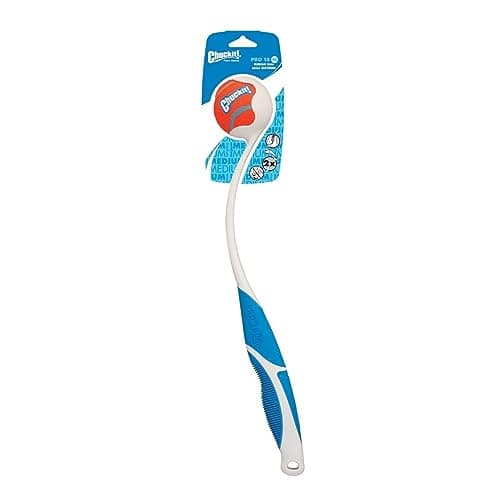
Medium-ball manual baseline: Chuckit! Pro Launcher 18M — exact Amazon model 248201; the M suffix identifies compatibility with medium Chuckit! balls.
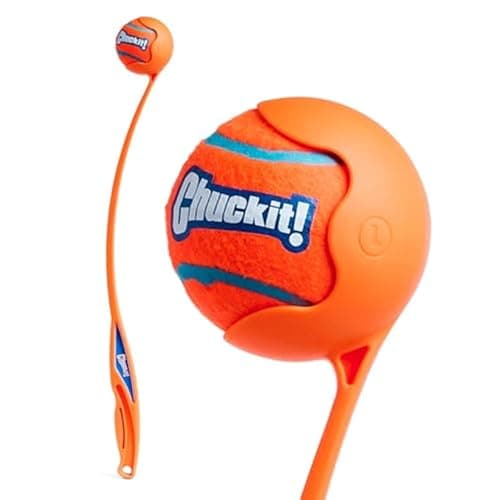
Large-ball manual option: Chuckit! Sport Launcher 26L — exact Amazon model 6700; the L suffix identifies the large-ball cup, and Petmate lists 27.8in overall dimensions.
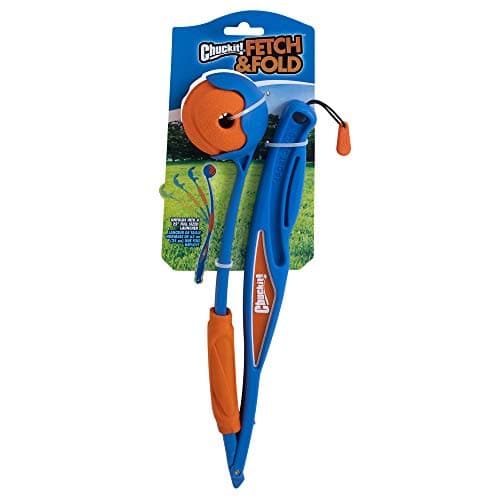
Folding medium-ball option: Chuckit! Fetch & Fold 25M — exact model 50739; 15.7in folded and 25in unfolded according to Petmate.
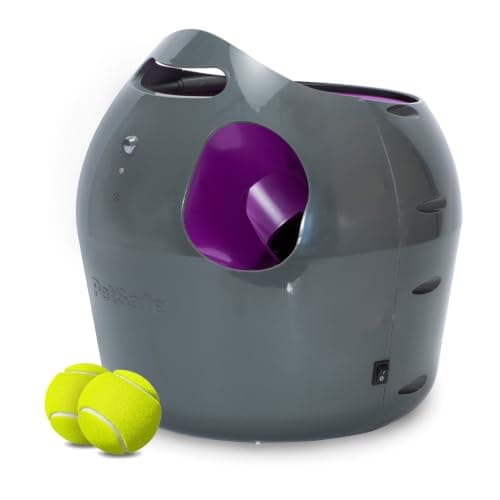
Automatic option: PetSafe Automatic Ball Launcher — exact UK model PTY19-15850; standard-size tennis balls, 2.5–9m maker range, nine distance and six angle settings.
Safety boundary: every option is for supervised play. Use an intact ball too large to fit wholly in the mouth, keep throws low, take regular breaks and stop if the dog is tired, hot, sore, lame, distressed or unable to disengage.
Dog ball launcher comparison: exact current models
Specifications are current maker statements, not DPR performance measurements. The four direct Amazon routes passed identity, model and availability checks on 31 July 2026; confirm the live variant before ordering.
Exact product
Format
Ball compatibility
Published size or settings
Amazon identity
Chuckit! Pro 18M
Manual
Medium Chuckit! ball
Petmate lists 2.6 × 3.6 × 20in overall
B0081Z77OI; model 248201
Chuckit! Sport 26L
Manual
Large Chuckit! ball
Petmate lists 3.3 × 4.3 × 27.8in overall
B001B4TV1I; model 6700
Chuckit! Fetch & Fold 25M
Folding manual
Medium Chuckit! ball
15.7in folded; 25in unfolded
B08C3X6Y2F; model 50739
PetSafe Automatic
Automatic; mains or batteries
Standard-size tennis ball
2.5–9m; 9 distances; 6 angles
B017N6IF5U; model PTY19-15850
What actually matters here
Ball size before launcher length: S, M, L and XL are compatibility codes, and the ball must suit the individual dog’s mouth.
Manual, folding or automatic operation, including who controls each launch and where the dog must stand.
A clear, obstacle-free launch path with enough room for the lowest useful setting; published maximum range is not a target.
Exact current model, variant and ball format behind the earning button rather than a category-level product name.
Supervision, regular breaks, stable footing and checks for heat, fatigue, lameness, distress and toy damage.
Practical unknowns—noise, wet-ball feeding, jams, aim, pickup force and durability—when DPR has not measured them.
Who this is for
Owners who already know their dog enjoys supervised fetch and can return an appropriately sized ball.
Buyers choosing between a medium-ball, large-ball, folding or automatic format.
People willing to control the session, inspect the ball and stop before the dog self-selects a limit.
Who should skip
Still-growing, elderly, injured, arthritic, overweight or joint-risk dogs until a vet has advised on suitable exercise.
Any dog for whom the compatible ball can fit wholly in the mouth, or that chews, tears or swallows ball material.
Unattended play. PetSafe’s own training guidance says the automatic launcher should be used only while supervised.
Wet, slippery or unstable ground, cramped indoor routes, hot or humid conditions, and play around people or animals crossing the launch path.
Choose the ball size before the launcher length
Chuckit suffixes describe ball compatibility: S for small, M for medium, L for large and XL for extra large. They are not dog-size prescriptions. PDSA says a fetch ball should be large enough that the dog cannot fit the whole thing in the mouth while remaining comfortable to carry.
That makes the current 18M and 25M choices unsuitable for any dog that can swallow their medium ball, regardless of breed label or body weight. The 26L provides a large-ball cup, but the owner still has to check comfortable carrying, intact condition and the exact current replacement-ball size.
Manual and automatic launchers solve different jobs
A manual launcher keeps the person responsible for every throw and makes it easy to alternate fetch with walking, sniffing and rest. The Fetch & Fold adds storage convenience, but its hinge has to be unfolded, locked and checked before use.
PetSafe’s training guidance says to introduce the sound gradually, teach the dog to stand to the side and use the launcher only under supervision. Its sensors, tone and rest mode are additional controls, not permission to leave a dog alone with the machine.
Set up fetch around the dog, not the maximum range
Blue Cross advises against throwing upward and suggests waiting until the toy lands before releasing the dog. PDSA recommends keeping balls low, giving regular breaks and building activity gradually, with a gentle walk as a warm-up and cool-down.
PDSA’s exercise guidance says to avoid thrown fetch for dogs that are still growing, elderly, injured, arthritic, overweight or prone to joint problems, and on wet, slippery or unstable surfaces. There is no evidence-based universal three-session schedule or single puppy age cutoff; maturity and suitable exercise vary.
Standard tennis balls are a documented trade-off
PetSafe specifies standard-size tennis balls, while the Chuckit products are sold around their matching S/M/L ball system. PDSA says the outer coating on standard tennis balls can slowly wear tooth enamel, particularly with repeated chewing or carrying, and that damaged or slippery balls can add choking risk.
Do not generalise that warning into a claim that every launcher-compatible dog ball is safe. Inspect before and during play, replace cracking, torn or loose material, prevent chewing between throws and ask a vet about tooth wear, mouth pain or a ball size that is difficult to judge.
What current owner questions changed
Current dog-owner discussions repeatedly ask whether the dog will self-load an automatic launcher, how noise affects introduction, whether wet or slobbery balls jam, which replacement-ball size fits, and whether the throw can be controlled in a smaller space. Recent threads about wet-ball feeding and self-loading and manual-versus-automatic objections are demand signals and anecdotes, not product-performance evidence.
Those questions changed the buying order: ball size and supervision now come first, the table separates manual from automatic formats, and every card states which practical outcomes DPR has not measured. An automatic launcher is not presented as solo exercise, and a treat puzzle no longer occupies a launcher recommendation slot.
What the purchase-path audit changed
The two former Chuckit destinations were exact and in stock, but the old page misread 26L as a simple 26-inch distance choice. It is the large-ball variant and Petmate lists 27.8in overall dimensions. The former third route was also exact and in stock, but it opened a 4-inch treat-dispensing puzzle ball rather than any kind of launcher, so it was removed.
The revised page adds exact in-stock Fetch & Fold 25M model 50739 and PetSafe automatic model PTY19-15850 routes. The retained Pro 18M model 248201 and Sport 26L model 6700 routes remain live. Availability can change, so confirm the title, ball format, model and seller before ordering.
Quick questions before you buy
What is the best dog ball launcher in the UK?
There is no universal winner. Pro 18M is the medium-ball manual baseline, Sport 26L takes a large Chuckit ball, Fetch & Fold 25M folds for storage, and PetSafe PTY19-15850 is the adjustable automatic option. Ball size, space and supervision come before format.
Is a manual or automatic dog ball launcher better?
A manual launcher gives the person direct control over every repetition. An automatic launcher adds adjustable settings and a training task but still requires supervision. Choose automatic only if the ball size, sound, launch path and supervised routine suit the individual dog.
A simple manual launcher using medium Chuckit! balls
“18M” is a product-size code, not a promise that this is the right ball for every medium or large dog. DPR has not measured throw distance, release consistency, pickup force, comfort or durability.
A manual launcher whose cup takes large Chuckit! balls
The longer overall format needs more clear swing and storage space. A large ball is not automatically comfortable for every large dog, and DPR has not compared control, release or distance with the 18M.
A folding manual launcher using medium Chuckit! balls
The hinge adds a setup and inspection point that the one-piece manuals do not have. DPR has not verified lock wear, release consistency, bag fit or the maker’s “same power and distance” statement.
A supervised automatic format with adjustable launch settings
PetSafe still directs supervised use. DPR has not measured noise, aim, sensor coverage, wet-ball jams, training success or the rest cycle, and the required standard tennis-ball format has dental and choking trade-offs for some dogs.
££££
Recommended picks
Medium-ball manual baseline
Best for: A simple manual launcher using medium Chuckit! balls
Chuckit! Pro Launcher 18M — Medium£
Why it made the list: The current Petmate specification identifies the 18M as the medium-ball Pro variant, with a flexible plastic shaft, pickup cup and 2.6 × 3.6 × 20in overall dimensions. Amazon returned this exact route as model and part 248201.
Main drawback: “18M” is a product-size code, not a promise that this is the right ball for every medium or large dog. DPR has not measured throw distance, release consistency, pickup force, comfort or durability.
Typical price band: £
Pros
Exact medium-ball 18M variant.
Published pickup cup and flexible-plastic construction.
No battery, charging or automatic feed path.
Cons
Medium ball may be unsafe for a dog that can swallow it.
Chuckit! Sport Launcher 26L — Large — a manual launcher whose cup takes large Chuckit! balls
Chuckit! Fetch & Fold Launcher 25M — a folding manual launcher using medium Chuckit! balls
Best for: A manual launcher whose cup takes large Chuckit! balls
Chuckit! Sport Launcher 26L — Large£
Why it made the list: The current Sport Launcher specification says launcher codes ending in L take large Chuckit! balls. Petmate lists the 26L at 3.3 × 4.3 × 27.8in overall; Amazon returned this exact large-ball route as model and part 6700.
Main drawback: The longer overall format needs more clear swing and storage space. A large ball is not automatically comfortable for every large dog, and DPR has not compared control, release or distance with the 18M.
Typical price band: £
Pros
Exact large-ball L variant.
Published 27.8in overall dimension.
No battery or automatic loading mechanism.
Cons
Needs clear swing and storage space.
Large-ball comfort still needs an individual check.
Chuckit! Fetch & Fold Launcher 25M — a folding manual launcher using medium Chuckit! balls
PetSafe Automatic Ball Launcher PTY19-15850 — a supervised automatic format with adjustable launch settings
Best for: A folding manual launcher using medium Chuckit! balls
Chuckit! Fetch & Fold Launcher 25M£
Why it made the list: The current Fetch & Fold specification identifies a 25M medium-ball launcher with a locking nylon hinge, 15.7in folded length and 25in unfolded length. Amazon returned the exact route as model and part 50739.
Main drawback: The hinge adds a setup and inspection point that the one-piece manuals do not have. DPR has not verified lock wear, release consistency, bag fit or the maker’s “same power and distance” statement.
Typical price band: £
Pros
Exact medium-ball model 50739.
Published 15.7in folded and 25in unfolded lengths.
PetSafe Automatic Ball Launcher PTY19-15850 — a supervised automatic format with adjustable launch settings
Chuckit! Pro Launcher 18M — Medium — a simple manual launcher using medium Chuckit! balls
Best for: A supervised automatic format with adjustable launch settings
PetSafe Automatic Ball Launcher PTY19-15850
Why it made the list: The current PetSafe UK specification lists standard-size tennis balls, nine distance settings, six angle settings, a 2.5–9m launch range, warning tone, motion/safety sensors and capacity for up to three balls. Amazon returned the exact UK model and part PTY19-15850.
Main drawback: PetSafe still directs supervised use. DPR has not measured noise, aim, sensor coverage, wet-ball jams, training success or the rest cycle, and the required standard tennis-ball format has dental and choking trade-offs for some dogs.
Typical price band: ££££
Pros
Exact UK model PTY19-15850.
Nine distance and six angle settings.
Published tone and motion/safety sensors.
Cons
Supervised use only.
Standard tennis-ball compatibility is a material trade-off.
Noise, wet-ball handling and training success are untested here.
For dogs whose main behaviour is chewing rather than retrieving.
FAQ
What is the best dog ball launcher in the UK?
There is no universal winner. Pro 18M is the medium-ball manual baseline, Sport 26L takes a large Chuckit ball, Fetch & Fold 25M folds for storage, and PetSafe PTY19-15850 is the adjustable automatic option. Ball size, space and supervision come before format.
Is a manual or automatic dog ball launcher better?
A manual launcher gives the person direct control over every repetition. An automatic launcher adds adjustable settings and a training task but still requires supervision. Choose automatic only if the ball size, sound, launch path and supervised routine suit the individual dog.
What do 18M, 25M and 26L mean on Chuckit launchers?
The suffix is the key compatibility clue: M takes medium Chuckit balls and L takes large Chuckit balls. The number is a product variant code and should not be treated as the exact overall length; check the current maker dimensions.
Can I leave a dog alone with an automatic ball launcher?
No product on this page is recommended for unattended use. PetSafe’s own training guidance says the automatic launcher should be used only under supervision, even though it has a warning tone, sensors and a rest mode.
Are tennis balls safe for a dog launcher?
PetSafe specifies standard-size tennis balls, but PDSA says standard tennis-ball coating can slowly wear enamel with frequent chewing or carrying, and undersized or damaged balls can create choking risk. Confirm size, prevent chewing, inspect often and replace damage.
Are ball launchers safe for puppies?
PDSA advises avoiding repetitive high-impact fetch while a dog is still growing. Dogs mature at different rates and the common fixed “five-minute rule” is not evidence-based, so ask the veterinary team about suitable play for the individual puppy.
How long should a dog play fetch?
There is no evidence-based fixed duration for every dog. Begin conservatively, use regular breaks and mix in walking and sniffing. Stop for heat, fatigue, soreness, lameness, distress, loss of control or damaged equipment.
What to buy alongside
Optional extras that may help with the task on this page. Check size, compatibility and care instructions before buying; these are category searches, not products tested by Dog Product Reviews.
Chuckit! replacement ball — Medium
Pro 18M and Fetch & Fold 25M take the maker’s M ball size. Confirm that medium is too large for the dog to swallow and verify the final product size before buying.
The automatic launcher is documented for standard-size tennis balls. Confirm exact compatibility, mouth safety and condition; do not leave balls for chewing.