Three small-dog harnesses compared by exact current size bands, entry style, adjustment and fit limits. Research-led UK guidance with no escape-proof or comfort guarantees.
Affiliate disclosure: Some links below are affiliate links. If you buy through one, Dog Product Reviews earns a commission at no extra cost to you. As an Amazon Associate I earn from qualifying purchases. Full disclosure.
Evidence: research-led. Dog Product Reviews has not fitted, walked, pull-tested, escape-tested, washed or durability-tested these exact harnesses. We checked the current Puppia and Julius-K9 model pages and size guidance, then applied current Dogs Trust guidance on shoulder freedom, entry style, fit, slip checks and wear inspection. How we assess products.
Main drawback: The neck opening is not a clip-around route for a head-shy dog, and this page has not tested pressure, rubbing or escape resistance. Select from measurements and use the supervised fit checks above.
Skip if: Any dog whose neck or chest falls outside the exact selected model’s current chart.
“Small dog” is not a size. The three linked products start from materially different measurements, use different entry styles and are not interchangeable just because a retailer lists them in the same category.
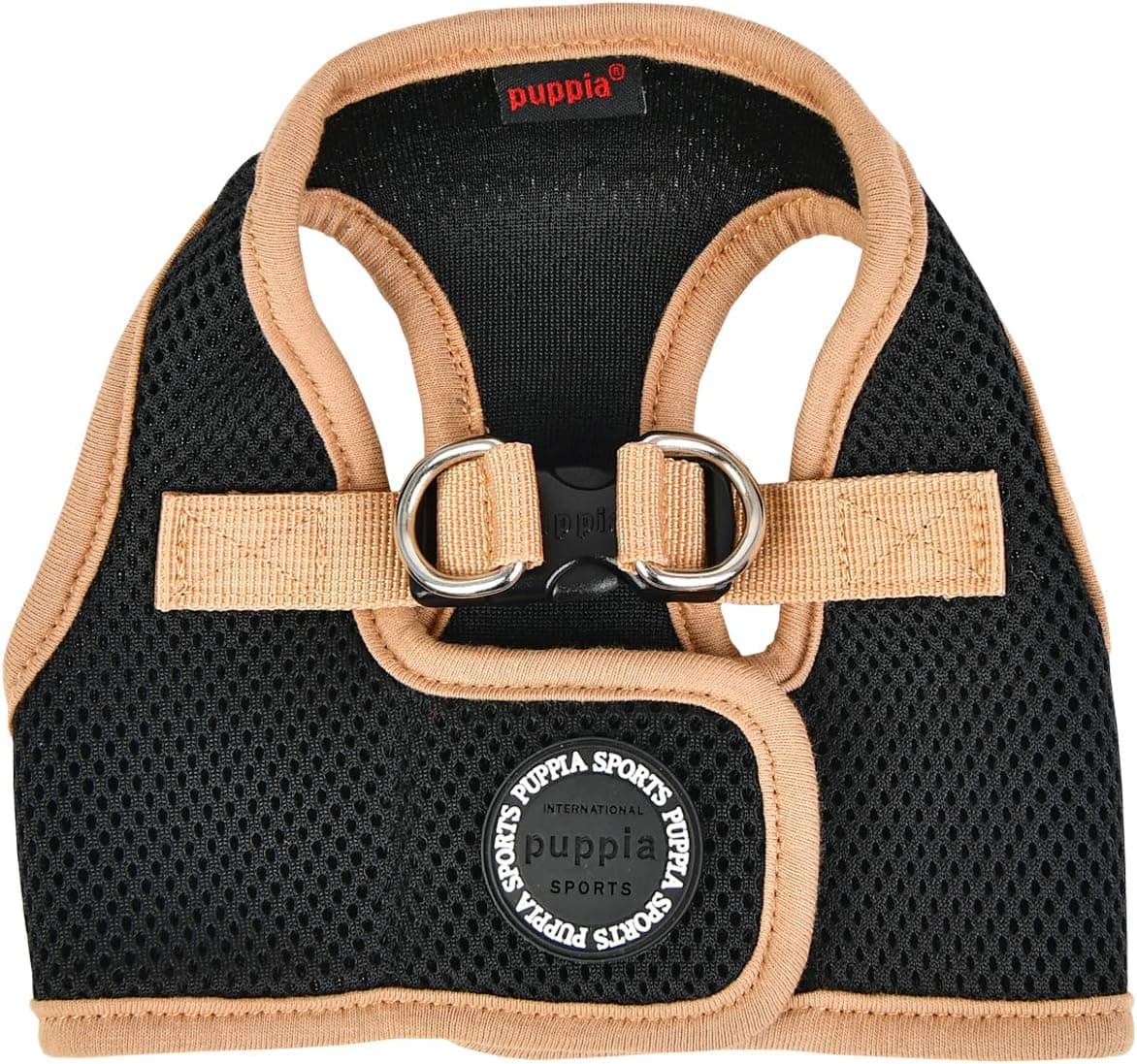
The Puppia Soft Harness is an over-head mesh design; the exact Two Tone Soft Vest Harness B II route is a step-in Black/M; and the Julius-K9 IDC option compared here is S/Mini for a published 49–67cm chest and 7–15kg guide. That last option is too large for many toy dogs.
Dogs Trust advises avoiding designs that restrict natural shoulder movement, using an entry style the dog can tolerate, fitting so one finger sits comfortably between strap and body, and checking that the dog cannot slip out. A product name cannot replace that individual movement and reverse-out check.
Quick answer:
Over-head mesh option: Puppia Soft Harness — current XS starts at a 7.5in (about 19cm) neck and 9–12.5in (about 23–32cm) chest; choose the exact measured size.
Verified step-in option: Puppia Two Tone Soft Vest Harness B II, Black/M — the linked variant uses chest-only sizing and a non-adjustable neck opening.
Structured S/Mini option: Julius-K9 IDC Powerharness — the linked size is 49–67cm around the chest and 7–15kg, so it is not a tiny-dog default.
What actually matters here
The exact current manufacturer chart and measurement point, not breed or weight alone.
An entry style the dog can tolerate: over-head and step-in are different buying decisions.
A fitted shoulder, neck and chest position that permits natural movement.
A one-finger fit check plus a supervised reverse-out and rotation check before street use.
Routine checks for rubbing, rotation, wear, damage or a change in gait.
Who this is for
Dogs whose current neck and chest measurements fit one exact published band.
Owners comparing an over-head mesh harness with a step-in vest or structured back-clip design.
Owners able to check fit while the dog stands, walks, turns and gently reverses under supervision.
Who should skip
Any dog whose neck or chest falls outside the exact selected model’s current chart.
Dogs with repeated escape attempts: none of these products is presented as escape-proof.
Owners seeking a crash-tested car restraint or a front-and-back two-point training harness.
Compare entry style and the exact smallest size
Puppia Soft is over-head; Puppia Two Tone Soft Vest B II is step-in; Julius-K9 IDC is pulled over the head and closed around the body. Head-shy dogs may need a clip-around-neck design that is not in this three-product shortlist.
Use the exact model chart rather than assuming “XS”, “Mini” or a breed label means the same thing across brands. The three current ranges use different measurement bands and adjustment systems.
Run the fit check before a pavement walk
Measure at the point shown by the maker, fit the harness while the dog stands and confirm one finger sits comfortably between strap and body. Watch the shoulder and front legs while the dog walks and turns; stop if the harness shifts, rubs, restricts movement or changes gait.
In a secure indoor or enclosed area, gently check whether the fitted harness rotates or allows the dog to reverse out. This is an individual check, not proof that the design is escape-proof. Recheck after adjustment and as a puppy grows or body condition changes.
Introduce the entry style gradually
Dogs Trust recommends letting the dog investigate the harness and pairing each stage with food before fastening it. If the dog retreats or looks worried, remove the harness and return to the previous step rather than forcing the head or legs through.
A product that fits on paper can still be the wrong entry format for the individual dog. Choose between over-head, step-in and clip-around designs before choosing colour or price.
Quick questions before you buy
Is a step-in harness best for every small dog?
No. Entry preference and body shape differ. The Puppia Two Tone Soft Vest B II is step-in, while the Puppia Soft Harness and Julius-K9 IDC are over-head designs. Choose a measured fit the dog can enter without distress.
How tight should a small-dog harness be?
Follow the exact maker instructions. Dogs Trust advises a comfortable one-finger space between strap and body, no movement of the harness while the dog moves and no ability to slip out.
The neck opening is not a clip-around route for a head-shy dog, and this page has not tested pressure, rubbing or escape resistance. Select from measurements and use the supervised fit checks above.
A structured back-attachment option for the exact S/Mini band
This is not a tiny-toy size. Julius-K9’s published welfare inspection says Powerharnesses are preferably for shorter city walks, and its user guidance warns that incorrect size, adjustment or lead use can let a dog escape. The former direct Amazon S/Mini variant is unavailable, so the button now opens an exact-name search.
Verified step-in format where the exact Black/M chest fits
Black/M is not a general choose-your-size route. The current M chart is 13.1–13.9in (about 33–35cm) at the chest, so buyers outside that narrow band should not use this ASIN.
£
Recommended picks
Over-head mesh option
Best for: Dogs comfortable with an over-head mesh harness
Puppia Soft Harness — choose exact size£
Why it made the list: Puppia classifies the current Soft Harness as over-head and publishes lightweight mesh, neck measurements and adjustable chest bands from XS to XXL. The XS chart is 7.5in at the neck and 9–12.5in at the chest.
Main drawback: The neck opening is not a clip-around route for a head-shy dog, and this page has not tested pressure, rubbing or escape resistance. Select from measurements and use the supervised fit checks above.
Typical price band: £
Pros
Current XS neck and chest measurements are published.
Lightweight soft mesh is a maker specification.
Hand wash or delicate cycle, then air dry.
Cons
Over-head entry.
No escape-proof claim.
Amazon search requires exact size and seller verification.
Julius-K9 IDC Powerharness S/Mini (49–67cm) — a structured back-attachment option for the exact S/Mini band
Puppia Two Tone Soft Vest Harness B II — Black/M — verified step-in format where the exact Black/M chest fits
Best for: A structured back-attachment option for the exact S/Mini band
Julius-K9 IDC Powerharness S/Mini (49–67cm)££
Why it made the list: The current Julius-K9 chart maps S/Mini to a 49–67cm chest and 7–15kg guide. The maker documents adjustable chest and abdominal straps, a back lead ring and a handle.
Main drawback: This is not a tiny-toy size. Julius-K9’s published welfare inspection says Powerharnesses are preferably for shorter city walks, and its user guidance warns that incorrect size, adjustment or lead use can let a dog escape. The former direct Amazon S/Mini variant is unavailable, so the button now opens an exact-name search.
Typical price band: ££
Pros
Exact S/Mini band is identified.
Chest and abdominal adjustment are documented.
Back ring and handle are documented.
Cons
Too large for many toy dogs.
Shorter-city-walk use boundary is published.
Search result requires exact size, seller and stock verification.
Puppia Two Tone Soft Vest Harness B II — Black/M — verified step-in format where the exact Black/M chest fits
Puppia Soft Harness — choose exact size — dogs comfortable with an over-head mesh harness
Best for: Verified step-in format where the exact Black/M chest fits
Puppia Two Tone Soft Vest Harness B II — Black/M£
Why it made the list: The current official product describes a step-in vest with cushioned mesh. The exact linked Black/M variant is chest-sized; Puppia states that the neck opening is non-adjustable.
Main drawback: Black/M is not a general choose-your-size route. The current M chart is 13.1–13.9in (about 33–35cm) at the chest, so buyers outside that narrow band should not use this ASIN.
Helpful if your small dog also needs a coat that works over the harness.
FAQ
Is a step-in harness best for every small dog?
No. Entry preference and body shape differ. The Puppia Two Tone Soft Vest B II is step-in, while the Puppia Soft Harness and Julius-K9 IDC are over-head designs. Choose a measured fit the dog can enter without distress.
How tight should a small-dog harness be?
Follow the exact maker instructions. Dogs Trust advises a comfortable one-finger space between strap and body, no movement of the harness while the dog moves and no ability to slip out.
Is any harness on this page escape-proof?
No. Dog Product Reviews has not escape-tested these products, and Julius-K9 explicitly warns that incorrect size, adjustment or lead use can permit escape. Run a supervised reverse-out check in a secure area.
Is Julius-K9 S/Mini suitable for a tiny toy dog?
Usually not if the dog falls below the published range. The exact linked S/Mini guide is 49–67cm around the chest and 7–15kg; many toy dogs need a smaller model or a different product.
Can these walking harnesses be used as car restraints?
This page does not present any of the three as an independently crash-tested car restraint. Use a vehicle restraint only according to its exact current instructions and evidence.
What to buy alongside
Optional extras that may help with the task on this page. Check size, compatibility and care instructions before buying; these are category searches, not products tested by Dog Product Reviews.
Soft body-measuring tape
Measure at the exact neck and chest points in the maker chart before selecting a size, then record the figures for future rechecks.