Affiliate disclosure: Some links below are affiliate links. If you buy through one, Dog Product Reviews earns a commission at no extra cost to you. As an Amazon Associate I earn from qualifying purchases. Full disclosure.
A lightweight, current-generation back-plus-chest-attachment Amazon route.
Evidence: research-led
Main drawback: The older clearance generation has only a back attachment, while Amazon results can mix generations, sizes, colours and sellers. Confirm the current 30821 style, two attachments and measured band before buying.
Skip if: The exact result is not the current two-attachment Hi & Light generation, the measured girth misses its chart, or a trial fit rides up, rotates, rubs, changes movement or allows slipping.
There is no universal Pomeranian harness size. The Royal Kennel Club publishes ideal breed-standard weights and describes a compact, well-ribbed body with an abundant coat, but it also says individual dogs may be larger or smaller. Those details describe an ideal show standard; they do not select XS, XXS or any retail size.
This page now owns one purchase decision: matching an everyday walking harness to the individual Pomeranian and the exact current model chart. It does not turn breed, weight, sex, age or coat volume into a size, and it does not promise to stop pulling, prevent escape or treat a medical condition.
The shortlist compares three distinct routes. Current-generation Ruffwear Hi & Light is a two-attachment Amazon option measured at the widest rib cage; Puppia Soft A PDCF-AC30 is an over-head, back-attachment mesh option requiring both neck and chest checks; PerfectFit Pomeranian is a modular neck-buckle route bought directly from its maker. The two Amazon routes can earn DPR a commission; the PerfectFit route does not.
Quick answer:
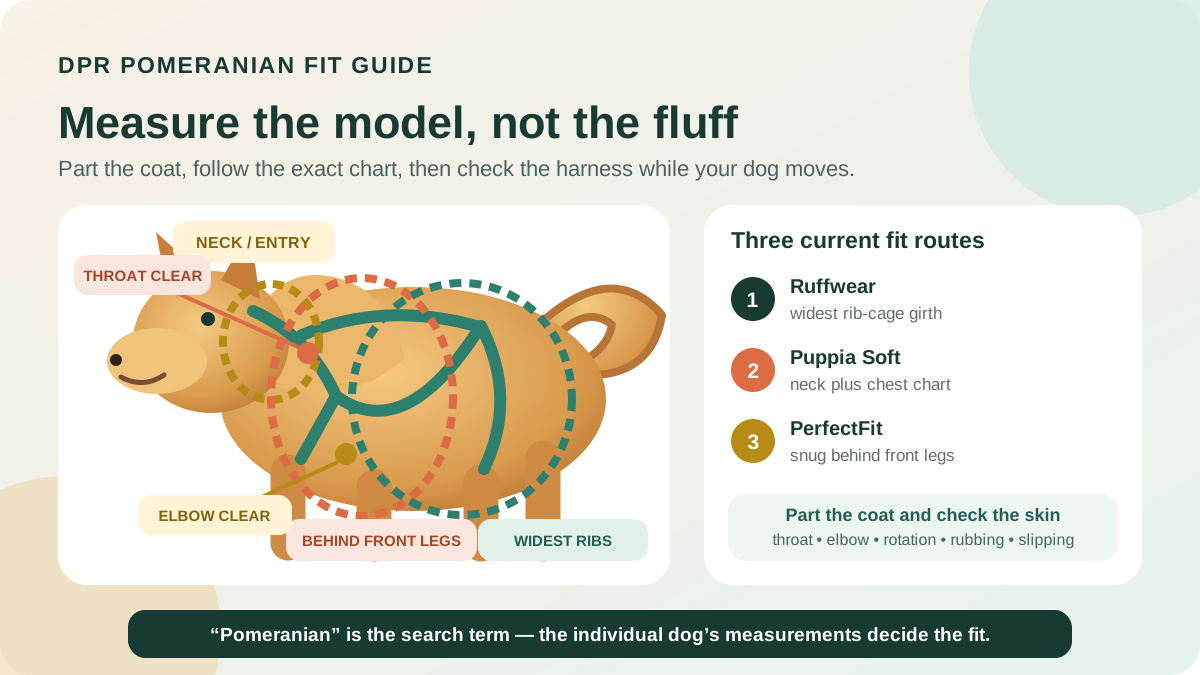
Measure for the exact model. Ruffwear uses the widest rib cage; Puppia Soft PDCF-AC30 requires the exact seller’s neck and chest chart; PerfectFit asks for a snug girth immediately behind the front legs.
Best-documented two-attachment Amazon route: current Ruffwear Hi & Light. It publishes four adjustments, a back aluminium V-ring, reinforced chest webbing and widest-rib-cage bands beginning at 23 cm.
Simple mesh Amazon route: Puppia Soft Harness A PDCF-AC30. It has a fixed neck opening, adjustable chest belt and back attachment. It is an over-head harness, not a step-in harness.
Modular direct route: PerfectFit Pomeranian Harness. It publishes five adjustments, replaceable pieces, neck-and-body buckles and maker fitting support. Its displayed preset is not “the Pomeranian size”.
Part the coat before checking. Confirm strap-to-skin position, throat and elbow clearance, rotation, rubbing and reverse-out risk rather than judging the outline of the fur.
Pomeranian harness comparison: three current fit routes
These are current maker-published specifications, not Pomeranian fit, comfort, pulling, escape or durability findings from Dog Product Reviews. Reopen the exact chart, model and stock selector before ordering.
Four adjustments; aluminium back V-ring; reinforced chest webbing; over-head entry with two girth buckles.
Measure the widest rib cage. Current bands begin at XXXS 23–33 cm; choose the larger band when between sizes.
The current and older clearance generations differ. Amazon results can mix models, variants and sellers; confirm the exact generation and measured size.
Replaceable modular pieces; five adjustments; neck and body buckles; top and front D-rings; 30°C wash.
Measure snugly just behind the front legs, then use the finder or sizing team. The rendered 34–40 cm preset is only a starting route.
Direct non-affiliate route. PerfectFit says it is not an anti-pull device and its front D-ring must never be used alone.
What actually matters here
Identify the exact model and generation before opening its chart; “small” and “Pomeranian” do not identify a size.
Use every measurement the exact chart requests. Do not convert breed, weight, sex, puppy age or coat volume into XS or XXS.
Part the coat and check the actual strap position at the neck, chest, throat and behind the elbows.
Confirm the fitted harness stays centred, allows the dog to walk and turn normally and cannot begin to slip over a shoulder.
Choose over-head or neck-buckle entry according to the individual dog’s handling response.
Choose attachment hardware for the walking job; a back ring or chest loop is not a training, medical, comfort or security result.
Confirm exact model, generation, measured band, seller, stock, components and unused-return terms before paying or removing tags.
Who this is for
Pomeranian owners comparing a current two-attachment, mesh or modular everyday walking route.
Dogs whose neck and chest fall into different bands or whose dense coat makes an outside-only visual check unreliable.
Growing dogs and adults whose current measurements, entry response and moving fit matter more than a breed label.
Who should skip
You want breed, weight or an XS/XXS label to choose the size without checking the exact current model chart and trial fit.
Repeated backing out is the main risk; compare a secure-body design and individual backup plan rather than assuming an everyday harness is escape-proof.
You need vehicle restraint, mobility support or a pulling-sport harness; these are different product jobs.
The dog has persistent coughing, gagging, breathing difficulty, pain, hopping, limping or a changed gait; seek veterinary assessment rather than treating equipment as a remedy.
Why “Pomeranian” is not a harness size
The Royal Kennel Club Pomeranian standard gives ideal show weights and describes a compact, short-coupled, well-ribbed body beneath an abundant double coat. It also says an individual dog may be larger or smaller than the listed ideal.
Breed-standard weight, sex, age and coat outline are not the maker’s neck or girth measurement. Choose from the exact current model’s neck and chest chart, not the breed, weight or an XS/XXS label.
This page stays distinct from the small-dog harness guide by applying three exact current systems to Pomeranian fit questions. The measurement guide owns the wider cross-brand method.
Ruffwear Hi & Light: check the current generation
Ruffwear currently publishes four adjustment points, an aluminium back V-ring and reinforced chest webbing. Its chart uses widest-rib-cage girth, beginning with XXXS 23–33 cm, XXS 33–43 cm and XS 43–56 cm.
Ruffwear says to choose the larger band when a measurement sits between bands. That is model-specific guidance, not permission to infer XXXS, XXS or XS from Pomeranian, kilograms, sex or age.
The current style 30821 has both back and chest attachments. Ruffwear’s older clearance Hi & Light generation has only a back attachment, so the similar name is not enough. Confirm the current two-attachment design in the Amazon result, then verify seller, stock, measured band, colour and returns route.
The Amazon button opens an exact-name search. It is not a fixed variant or assurance of stock; confirm model generation, size, seller and purchase terms on the destination.
Puppia Soft A: neck and chest must both match
Puppia’s current shop page identifies the Soft Harness A as polyester air mesh with a fixed neck opening and adjustable chest belt. Puppia Soft is an over-head harness, not a step-in harness.
Measure the neck at its thickest point and the chest at its widest point behind the front legs. The fixed neck and adjustable chest must both match the exact PDCF-AC30 chart shown by the seller; a chest match does not cancel a neck mismatch.
Official Puppia chart values differ between current market pages or catalogue generations. Rather than publishing one apparently universal XS table, this guide requires the exact model code and the chart attached to the exact UK listing. Keep a copy of that chart when ordering.
Puppia documents hand washing as preferred, with delicate machine washing permitted and air drying rather than tumble drying. Those care instructions do not prove long-term mesh, buckle or colour durability.
PerfectFit: modular pieces and neck-buckle entry
PerfectFit’s current Pomeranian route publishes five adjustment points, replaceable modular pieces, neck-and-body buckles, top/front D-rings and a maker-stated 30°C machine wash. It asks for a snug rib-cage girth immediately behind the front legs.
The rendered Tiny Top 3 plus Base 6 preset and 34–40 cm adjustment range are a starting configuration, not “the Pomeranian size”. PerfectFit directs between-size, growing or unusually shaped dogs to its sizing team with measurements and photographs.
PerfectFit says the harness is not an anti-pull device. Its current FAQ says the front D-ring must never be used alone: pair it with the back ring and a double-ended lead if following that setup.
The PerfectFit button goes directly to the manufacturer and earns Dog Product Reviews no commission. Maker comfort, movement and security language remains manufacturer information rather than a DPR finding.
Measure beneath a dense coat without guessing
The abundant coat can hide the body line, buckle and strap edge. Part the fur at the maker’s measurement line, place the soft tape around the body itself and follow that maker’s tension instruction. Do not add loose space merely for the outside outline of the coat or pull the tape tight enough to compress the body.
Repeat the part-and-look check after fastening. Confirm that no tuft is trapped in a buckle, the strap lies flat rather than twisting and the edge can be inspected at the throat, chest and behind the elbows.
Dogs Trust advises one finger comfortably beneath the straps, but the finished check is more than a finger rule: the harness should remain positioned during movement and the dog should not be able to slip out. Follow any more specific adjustment instruction for the exact model.
After a short indoor trial, part the fur again and inspect the skin. Redness, hair breakage, matting, moisture, heat, persistent scratching or a shifted strap means the fit needs reassessment rather than being hidden by the coat.
Entry style and puppy introduction are fit decisions
Ruffwear Hi & Light and Puppia Soft go over the head. PerfectFit clips around the neck and body. Dogs Trust notes that a clip-around-neck design may suit a dog that is worried by over-head entry; it does not make one format universally better.
Introduce the chosen harness in short, calm steps with food or another reward the individual dog values. Let the dog investigate, reward voluntary approach and build from touching the body to one opening or buckle. Stop and step back if the dog retreats, freezes or shows distress.
A puppy can move between chart bands quickly, but there is no reliable age-to-size timetable. Measure before each purchase and recheck whenever the harness changes position, adjustment nears its limit or the dog’s body or coat changes.
Do not leave extra looseness as “growing room”. The current fit still needs to remain positioned and resist slipping today.
Check the fitted harness while the dog moves
Dogs Trust advises avoiding harnesses that cross directly in front of the shoulders and restrict natural movement, allowing one finger comfortably beneath the straps, ensuring the harness stays positioned and checking that the dog cannot slip out.
Check indoors while the Pomeranian stands, walks, turns, sits and lowers its head. Look for the chest section rising towards the throat, contact behind the elbows, rubbing, persistent rotation, shortened steps, distress or the beginning of a shoulder reversing through an opening.
If neck and chest land in different Puppia bands, do not average them or choose from chest alone. Use a route with more independent adjustment or ask the maker’s fitting team. The same principle applies when one Ruffwear or PerfectFit section cannot stay correctly positioned.
Keep tags and the receipt during the indoor check. Recheck after growth, body-condition or coat change, strap adjustment, washing, a wet walk or visible wear, and stop using a harness that cannot stay clear and stable.
A front attachment is management hardware, not training
Current Ruffwear Hi & Light documents a reinforced chest loop; PerfectFit documents a front D-ring used with its back ring; Puppia Soft PDCF-AC30 is a back-attachment route. These facts describe hardware, not a proven pulling or training result on an individual Pomeranian.
Follow the exact maker rule. PerfectFit’s front D-ring must be paired with the back ring and must never be used alone. Ruffwear documents a different chest-webbing setup, while Puppia does not document a chest attachment for this model.
If pulling is the main problem, compare attachment jobs on the front-clip versus back-clip guide and pair equipment with reward-based loose-lead training. A front attachment is management hardware, not training.
Coughing and breathing are veterinary boundaries
PDSA’s Pomeranian guidance lists tracheal collapse among conditions that can affect the breed. A harness moves the walking attachment away from the neck; it is not treatment for tracheal collapse and does not prove a no-pull result.
Persistent coughing, gagging, breathing difficulty, pain or a changed gait needs veterinary assessment. Stop the activity and remove pressure if equipment appears to trigger a sign, but do not use a new harness, chest clip or fit adjustment as a diagnosis or treatment.
Walking attachment and legal identification are separate. Subject to the exemptions in the Control of Dogs Order 1992, a dog on a highway or in a place of public resort must wear a collar bearing the owner’s name and address. A walking harness does not replace that requirement.
Escape, car use and all-day wear are separate questions
An everyday harness is not automatically escape-proof. If the dog can reverse a shoulder through an opening or has escaped before, use the secure-fit harness guide and an individual backup plan rather than overtightening an ordinary harness.
A walking ring is not crash-test evidence. PerfectFit explicitly says its harness has not been crash tested and does not recommend it for car use. Use the dog car-harness evidence guide for vehicle restraint and follow the exact vehicle and restraint instructions.
Do not assume an ordinary walking harness is suitable for unsupervised or all-day wear. Follow the exact maker instructions, remove it if it stays wet or catches on the environment and recheck skin, coat and strap position after use.
Questions Pomeranian owners are asking now
Recent owner discussions ask what to do when fur catches in a clasp, the chest fits but the front section is too long, a harness rises towards the throat, an arm slips through, the dog backs out or an over-head harness causes avoidance.
There is no reliable breed-wide size. Ruffwear Hi & Light asks for widest-rib-cage girth; Puppia Soft PDCF-AC30 requires its exact neck and chest chart; PerfectFit asks for a snug girth immediately behind the front legs. Use the current model chart and moving fit instead of ordering XXXS, XXS or XS from breed, weight, sex or age.
Is Ruffwear Hi & Light the best harness for every Pomeranian?
No. It is the featured Amazon route because the current generation publishes a small-girth chart, four adjustments and back plus chest attachments. DPR has not fitted it on a Pomeranian, and the individual dog’s measurements, entry response and finished moving fit decide suitability.
A lightweight, current-generation back-plus-chest-attachment Amazon route
The older clearance generation has only a back attachment, while Amazon results can mix generations, sizes, colours and sellers. Confirm the current 30821 style, two attachments and measured band before buying.
A simple mesh, back-attachment route when both neck and chest match
Puppia’s official charts differ across markets or generations. Match PDCF-AC30 to the exact seller chart, and do not choose it when the fixed neck opening and chest band cannot both fit.
A modular fit, neck-buckle entry and direct maker sizing support
Selection can be more involved. PerfectFit says the harness is not an anti-pull device and its front D-ring must be paired with the back ring using a double-ended lead.
££
Recommended picks
Best-documented two-attachment Amazon route
Best for: A lightweight, current-generation back-plus-chest-attachment Amazon route
Ruffwear Hi & Light Lightweight Dog Harness
Why it made the list:Ruffwear’s current page publishes four adjustment points, an aluminium back V-ring, reinforced chest webbing and widest-rib-cage bands beginning at 23 cm. It is selected for a documented small-girth route and two attachment points, not a DPR Pomeranian fit, pulling or durability result.
Main drawback: The older clearance generation has only a back attachment, while Amazon results can mix generations, sizes, colours and sellers. Confirm the current 30821 style, two attachments and measured band before buying.
Pros
Current widest-rib-cage chart begins at 23 cm.
Back and chest attachment points are documented on the current generation.
Four adjustments and explicit cold-wash, air-dry care instructions.
Cons
No Pomeranian fit, pressure, pulling, escape or durability test by DPR.
Over-head entry may not suit every dog.
Amazon generation, seller, stock and measured variant require checking.
Puppia Soft Harness A (PDCF-AC30) — a simple mesh, back-attachment route when both neck and chest match
PerfectFit Pomeranian Harness — a modular fit, neck-buckle entry and direct maker sizing support
Best for: A simple mesh, back-attachment route when both neck and chest match
Puppia Soft Harness A (PDCF-AC30)
Why it made the list:Puppia’s current Soft Harness page identifies polyester air mesh, a fixed neck opening and an adjustable chest belt. It requires neck and chest measurements, so it is included as a conditional exact-model route rather than a universal Pomeranian or XS recommendation.
Main drawback: Puppia’s official charts differ across markets or generations. Match PDCF-AC30 to the exact seller chart, and do not choose it when the fixed neck opening and chest band cannot both fit.
Pros
Exact PDCF-AC30 model identity.
Separate neck and chest measurements.
Lightweight air-mesh construction and adjustable chest belt.
Cons
Fixed, non-adjustable neck opening.
Official chart values differ across markets or generations.
Back attachment only; no independent Pomeranian performance result.
PerfectFit Pomeranian Harness — a modular fit, neck-buckle entry and direct maker sizing support
Ruffwear Hi & Light Lightweight Dog Harness — a lightweight, current-generation back-plus-chest-attachment Amazon route
Best for: A modular fit, neck-buckle entry and direct maker sizing support
PerfectFit Pomeranian Harness££
Why it made the list:PerfectFit’s current Pomeranian page publishes five adjustment points, replaceable modular pieces, neck-and-body buckles and top/front D-rings. Its displayed Tiny preset starts a fitting route; it does not prove a universal Pomeranian size.
Main drawback: Selection can be more involved. PerfectFit says the harness is not an anti-pull device and its front D-ring must be paired with the back ring using a double-ended lead.
Relative budget: ££. Check the retailer for the current price.
Pros
Five maker-published adjustment points.
Neck buckle avoids over-head entry.
Replaceable pieces and maker sizing support.
Cons
No independent Pomeranian fit, comfort, pulling or wear result.
Front D-ring cannot be used as a single attachment.
There is no reliable breed-wide size. Ruffwear Hi & Light asks for widest-rib-cage girth; Puppia Soft PDCF-AC30 requires its exact neck and chest chart; PerfectFit asks for a snug girth immediately behind the front legs. Use the current model chart and moving fit instead of ordering XXXS, XXS or XS from breed, weight, sex or age.
Is Ruffwear Hi & Light the best harness for every Pomeranian?
No. It is the featured Amazon route because the current generation publishes a small-girth chart, four adjustments and back plus chest attachments. DPR has not fitted it on a Pomeranian, and the individual dog’s measurements, entry response and finished moving fit decide suitability.
Should I choose Ruffwear, Puppia or PerfectFit?
Consider current Ruffwear Hi & Light when its widest-rib-cage chart fits and you need documented back and chest attachments. Puppia Soft PDCF-AC30 is a conditional mesh route when both its fixed neck and chest band fit. PerfectFit offers modular pieces, neck-buckle entry and maker sizing support. None has been independently fitted or performance-tested here.
Is Puppia Soft a step-in harness?
No. The Soft Harness A PDCF-AC30 has a fixed opening that goes over the head, an adjustable chest belt and a back attachment. Puppia sells other formats, so confirm the exact model rather than transferring features between products.
How do I measure a Pomeranian through a thick coat?
Part the coat at the exact maker-defined line and measure the body beneath it without compressing the body or adding loose space for the outer fur. After fitting, part the coat again to check strap-to-skin position, trapped hair, throat and elbow clearance, rubbing and rotation.
Can a harness prevent tracheal collapse in a Pomeranian?
No. A harness moves the walking attachment away from the neck but cannot prevent, diagnose or treat tracheal collapse. Persistent coughing, gagging or breathing difficulty needs veterinary assessment.
Does a front clip stop a Pomeranian pulling?
No attachment point replaces training. Current Ruffwear Hi & Light documents chest webbing; PerfectFit permits its front D-ring only with the back ring and a double-ended lead. Use the exact maker instructions and reward-based loose-lead training.
What size harness should I buy for a Pomeranian puppy?
Do not use an age-to-size shortcut. Measure immediately before buying and recheck whenever the harness changes position or nears its adjustment limit. Do not leave extra looseness as growing room; the harness still needs to stay positioned and prevent slipping today.
Can a Pomeranian wear an everyday harness in the car?
A walking attachment is not proof of crash testing. PerfectFit says its harness is not crash tested and does not recommend it for car use. Use a vehicle-restraint product with evidence for that exact job and follow the vehicle and restraint instructions.
Useful measuring and handling accessories
Optional extras that may help with the task on this page. Check size, compatibility and care instructions before buying; these are category searches, not products tested by Dog Product Reviews.
Soft body-measuring tape
Record every maker-defined measurement beneath the coat before buying and recheck after puppy growth or body-condition changes.