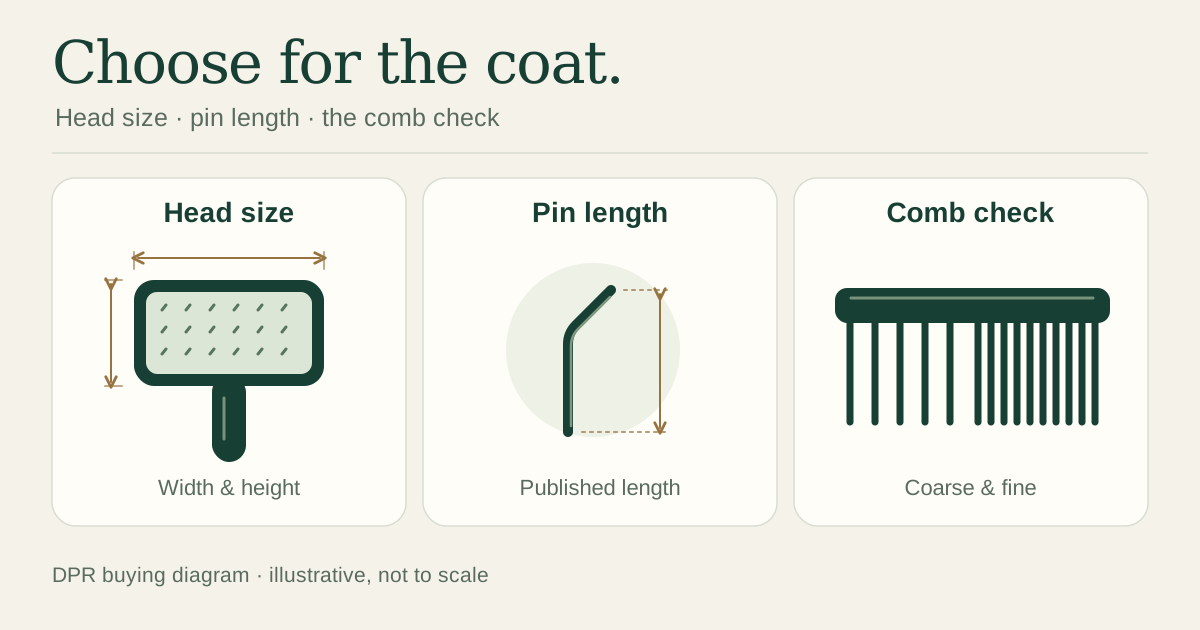
DPR buying diagram, not a Goldendoodle brushing trial. Compare the exact head sizes, pin lengths and coat roles below; illustrations are not to scale.
Affiliate disclosure: Some links below are affiliate links. If you buy through one, Dog Product Reviews earns a commission at no extra cost to you. As an Amazon Associate I earn from qualifying purchases. Full disclosure.
Evidence: research-led. Research-led, not a hands-on brush test. On 18 October 2026 we rechecked the Big G, Mark and Ancol manufacturer pages and PDSA grooming guidance. Published dimensions do not establish handling or coat fit. We have not brushed a Goldendoodle with these exact tools, timed sessions, measured comfort or tested durability. Amazon stock, prices and current listing contents are not verified. How we assess products.
These routes explain published tool roles, not a fit assessment. Keep a suitable brush you already own; a larger dog does not automatically need a larger head or a second brush.
Chris Christensen Big G Slicker Brush (Large or Medium)
Published long-coat option, with size chosen by body area.
Evidence: research-led
Main drawback: Comfort, speed and durability are untested here. Large and Medium are separate variants; the search can show both, so check the selected size rather than accepting its first result. Long pins do not make a tight mat safe to brush out.
Skip if: The coat is short, matted or painful, the job is only surface finishing, or you cannot control the head comfortably. Neither size is a universal Goldendoodle fit.
Start with the individual coat, then the area you need to brush. Within this shortlist, Chris Christensen places the 27mm Big G in its long-coat family and the 12mm Mark range in its short-coat family. Large and Medium Big G heads have different published body-area roles, not a Goldendoodle weight chart. A fine/coarse metal comb can provide feedback after brushing without forcing it through a catch.
A brush is for routine coat maintenance, not permission to pull through a tight mat. PDSA advises owners not to tackle mats at home, to stop if a pet is worried or stressed, and to ask a reputable groomer or vet for individual advice.
This page previously recommended one 12mm short-coat slicker as the universal adult Goldendoodle answer. We corrected that mismatch and removed unsupported prices, fixed session times, home dematting instructions and claims that every Goldendoodle has the same coat or never sheds.
Quick answer:
Long coat, body or legs: compare the separate Big G Large body row and Big G Medium smaller-area row. Both publish 27mm pins; Large does not mean “for every large dog”. You do not automatically need both.
Short or closely clipped coat: the Mark III Medium is the 12mm short-coat option here. Its single published head dimension cannot be used to rank its head area against Big G.
Gentle introduction or lighter surface work: Ancol 433000 has a pin-then-bristle format. The maker now lists 23 × 6.5cm brush size, but no pin length; this is not evidence of reach through a dense adult coat.
Comb check: after brushing a section, a fine/coarse metal comb should pass without force. If it repeatedly catches, do not turn the session into a pulling contest.
Existing mat: stop. PDSA says not to tackle mats at home; book a reputable groomer and seek veterinary advice if the skin is sore, wet, smelly or broken.
Goldendoodle brush comparison: choose by the actual coat
Manufacturer pages checked 18 October 2026. Head dimensions, whole-tool size and pin length are different measurements. Compare only like-for-like figures; none are DPR measurements or proof of comfort, speed or suitability.
A published size figure does not establish pin reach through a dense coat
What actually matters here
Published pin length matched to the current coat length: long pins for a long coat, shorter pins for a close clip.
A controllable head for the intended area; published dimensions do not prove faster grooming or less fatigue.
A flexible cushion and finished pins; use light pressure and stop if the dog flinches or the skin becomes red.
A metal comb as feedback after brushing, not as a tool to force through a knot.
Clear replacement signs: bent or missing pins, damaged tips, a split cushion or a loose head.
Who this is for
Owners choosing a routine brush for a long, wavy, curly, straight or recently clipped Goldendoodle coat.
Buyers deciding whether the Big G Large, Big G Medium or existing Mark III link fits the job.
Puppy owners building calm, reward-based handling before the adult coat is established.
Who should skip
Dogs with tight existing mats, painful skin, wounds or sudden coat change: use a reputable groomer or vet, not a shopping guide.
Anyone expecting a product to replace regular coat checks or professional grooming.
Buyers who want hands-on comfort, speed or durability results; Dog Product Reviews has not run those tests.
Big G Large or Medium: choose the area
The Large source row records a 3¾ × 3¾-inch head and 8-inch overall length; the maker assigns it to body work. The Medium source row records a 2⅜ × 3¾-inch head and 7⅜-inch overall length, with a legs, columns and poms role. Both have 27mm pins. These are manufacturer figures, not our measurements.
Choose for the area and your control, not the dog’s weight or a Mini/Standard label. If your existing brush works for the agreed coat-care task, there is no automatic reason to buy another. DPR has no timed comparison showing that the larger head is faster or that either is more comfortable.
The Big G buying card deliberately retains a search covering both sizes. Before paying, confirm Big G, the exact Large or Medium variant, seller and return terms. The separate evidence rows above help identify the intended variant; they do not certify a retailer offer.
Mark III after a short clip
A recently clipped coat can change the tool question without changing the dog. Chris Christensen’s published 12mm short-coat classification makes the Mark III record relevant to discuss with your groomer; it is not proof that every short coat needs this brush.
Do not compare its “5-inch head” directly with Big G’s two-axis dimensions. The Mark III source does not specify that head axis or a second dimension. Pin length is also not the depth the brush will safely reach into a coat. Ask for a demonstration if tool choice or pressure is uncertain, then review the Mark III buying card.
Ancol 433000: what the size figure means
The current Ancol product page lists 23 × 6.5cm for its brush sides, with no axes stated. The 2024/25 catalogue’s 24cm entry is historical, not a current verified length. Neither figure is a pin-length measurement or a reliable brush-head footprint.
For a gentle introduction or light finishing job, compare the documented pin-then-bristle sequence with what you already own. Although Ancol names several coat types, DPR has not established dense-coat reach or puppy comfort. Use the current source row and Ancol buying card only with those limits.
Coat first, crossbreed label second
Goldendoodles inherit coat traits in different combinations. GANA explains that they can be curly, wavy or straight and that furnishings genes affect shedding. A flat-coated, shedding Goldendoodle and a dense furnished curly Goldendoodle should not automatically receive the same tool.
Start with four observations: current clipped length, density near the skin, curl or wave, and whether loose hair is retained in the coat. Add skin sensitivity and the dog’s reaction to handling. If you are unsure, ask the groomer who can see and feel the coat to demonstrate an appropriate brush and pressure.
Do not buy a bigger head solely because the dog is larger. The Big G Large has a published body role; the Medium has a published legs/columns role. Two tasks do not automatically require two purchases; ask your groomer whether a suitable tool you already have can cover your plan.
Slicker first, comb as feedback
For a longer wavy or curly coat, work in small sections rather than polishing only the surface. Lift a layer, use controlled strokes without pressing pins into the skin, then move through the coat systematically. The metal comb is the check: it should pass through the finished section without force.
Use a non-slip surface where the dog cannot fall. A grooming table requires proper training, supervision and restraint knowledge; this page does not tell an owner to improvise with a bench or leave a dog elevated. Floor-level work on a non-slip mat is a valid safer option if it gives you control.
Pay extra attention to often-hidden, high-friction or damp areas such as under a collar or harness, behind the ears, armpits, legs, tummy and tail. The individual coat determines how frequently each area needs attention; stop rather than pulling through a tight mat.
How often should a Goldendoodle be brushed?
PDSA says poodle crosses may need brushing a few times a week. A long, dense or wet coat can need attention more often, including daily checks, while a short clip or flatter coat may require less. There is no defensible universal “20–30 minutes every day” rule for every Goldendoodle.
Use the comb and the coat as feedback. Check high-friction areas daily and do a complete section-by-section brush often enough that the comb passes without force. After wet walks, check the coat as it dries because PDSA notes that curled poodle-cross coats can be especially prone to knotting after they get wet.
During a puppy-to-adult coat change, reassess more often rather than relying on an age cut-off. Coat density and tolerance—not an arbitrary birthday—should determine when to change tools or frequency.
What to do when you find a mat
Do not use coin size as a safety test. Skin can be drawn up inside even a small mat, making scissors or bladed dematting tools hazardous. Do not force a slicker or comb through it, and do not assume a product labelled “dematting” makes home removal safe.
If the dog flinches, turns away, tries to escape or becomes stressed during routine brushing, stop. PDSA recommends slow, positive handling with treats and praise; persistent discomfort needs a coat, skin and tool-fit assessment rather than longer restraint.
Best brush for a Goldendoodle puppy
A puppy’s first brush should support calm handling, not maximise pin reach. A smaller soft slicker or pin brush can be easier to introduce than a large long-pin head. Touch the shoulder briefly, reward, and expand to paws, ears, legs and tail over multiple short sessions.
The Ancol pin-and-bristle format is included for its documented gentle introduction and finishing directions, not a verified low price or a puppy-fit test. Its unpublished pin length leaves coat-depth reach unknown. Ask the puppy’s groomer to demonstrate a suitable tool and reassess as the coat changes.
Do not upgrade at a fixed age. Change when the current tool no longer reaches the coat safely, when the clip changes, or when the groomer recommends a different pin length or firmness for the individual dog.
Should you use a FURminator on a Goldendoodle?
Do not choose an undercoat deshedding tool from the breed name alone. Goldendoodle coats and shedding vary. FURminator describes its tool as removing loose undercoat hair and says mats and tangles must be removed before use; it is not a mat-removal tool.
If the individual Goldendoodle has a shedding undercoat, ask a reputable groomer whether a deshedding tool is appropriate and which model matches the coat length. For a long furnished curly or wavy coat, start with coat-specific slicker and comb advice instead of a blanket deshedding rule.
How we researched these Goldendoodle brush picks
Dog Product Reviews has not run a controlled brushing trial. We did not measure scratching, pulling, coat breakage, session length, grip fatigue or pin wear. Recommendations are limited to current specifications and documented tool roles, with safety advice sourced to PDSA.
On 18 October 2026 we rechecked Chris Christensen’s Big G and Mark product pages, Ancol’s 433000 instructions and PDSA grooming guidance. We corrected the Ancol size statement and made the Mark III dimension limit explicit. The GANA coat-genetics explainer remains background context. Manufacturer dimensions are specifications, not measurements made by DPR; retailer stock, prices and live listing identity are not verified by this source review.
Quick questions before you buy
What is the best brush for a Goldendoodle?
For a long, dense coat, the Chris Christensen Big G is the documented long-coat option in this shortlist: 27mm pins, with the Large assigned to body work and Medium to legs and columns. For a short or closely clipped coat, the 12mm Mark III Medium is the documented short-coat option. Follow with a fine/coarse metal comb as a check, and choose for the actual coat rather than the breed label alone.
What is the best brush for a Goldendoodle puppy?
Ask the puppy’s groomer to demonstrate a controllable brush and gentle handling for the current coat. Ancol’s pin-and-bristle format has gradual-introduction directions, but no puppy-fit test or published pin length here. Use brief reward-based sessions and stop for stress. Do not change tools solely because the puppy reaches a fixed age.
Published long-coat option, with size chosen by body area
Comfort, speed and durability are untested here. Large and Medium are separate variants; the search can show both, so check the selected size rather than accepting its first result. Long pins do not make a tight mat safe to brush out.
Best exact linked option for a short or closely clipped coat
The maker places the 12mm Mark range in its short-coat category, not as a universal long-coat tool. Confirm Mark III Medium, the exact variant and seller on the destination before buying.
Published pin-and-bristle format for light finishing
Pin reach through a dense adult curly coat is unknown, and no puppy-specific fit trial is recorded. Do not force the tool through mats or assume a broad coat label proves it suits the individual dog.
Recommended picks
Long-coat option: choose the exact Big G size
Best for: Published long-coat option, with size chosen by body area
Chris Christensen Big G Slicker Brush (Large or Medium)
Why it made the list:Chris Christensen’s current Big G specification lists 27mm stainless-steel pins for long coats. The Large has a 3¾ × 3¾-inch head and is assigned to the body; the Medium has a 2⅜ × 3¾-inch head and is assigned to legs and columns. Choose the size for the area and your control, then check the result with a comb.
Main drawback: Comfort, speed and durability are untested here. Large and Medium are separate variants; the search can show both, so check the selected size rather than accepting its first result. Long pins do not make a tight mat safe to brush out.
Pros
27mm pins are documented for long coats.
Large and Medium heads have distinct published tasks rather than vague breed sizing.
Manufacturer specifies a flexible cushion pad and ergonomic handle.
Separate source-register rows distinguish Large body work from Medium smaller-area work.
Cons
The broad retailer search is not an exact-size offer or a stock check.
Large and Medium have different published head sizes; DPR has not compared brushing speed or handling.
No hands-on comfort, timing or wear result from Dog Product Reviews.
Chris Christensen Mark III Medium Slicker Brush — best exact linked option for a short or closely clipped coat
Ancol Ergo Double-Sided Pin & Bristle Brush — published pin-and-bristle format for light finishing
Best for: Best exact linked option for a short or closely clipped coat
Chris Christensen Mark III Medium Slicker Brush
Why it made the list:The current Mark specification gives the Mark III a 5-inch head, 7-inch body and 12mm pins, and classifies the Mark range for short coats. The head axis and second dimension are unspecified, so this is not a measured head footprint. Consider it for an appropriate short or closely clipped coat, not as a universal Goldendoodle brush.
Main drawback: The maker places the 12mm Mark range in its short-coat category, not as a universal long-coat tool. Confirm Mark III Medium, the exact variant and seller on the destination before buying.
Pros
Manufacturer identifies the Mark III Medium model separately from the other Mark shapes.
Maker lists head and body figures, with the head-axis limitation disclosed here.
12mm pins have a clear short-coat role.
Manufacturer specifies an extra-flexible cushion and beech-wood body.
Cons
Not the maker’s documented long-coat range.
The intended linked model is Mark III Medium; confirm the current listing, variant and seller before paying.
Pair with a comb when the coat length needs a near-skin check.
Ancol Ergo Double-Sided Pin & Bristle Brush — published pin-and-bristle format for light finishing
Chris Christensen Big G Slicker Brush (Large or Medium) — published long-coat option, with size chosen by body area
Best for: Published pin-and-bristle format for light finishing
Ancol Ergo Double-Sided Pin & Bristle Brush
Why it made the list:Ancol’s current product instructions describe a gentle pin-side pass followed by bristle-side smoothing. The 433000 page now lists brush size as 23 × 6.5cm for both sides and names short, long, wire-haired and thick coats. It does not identify the measurement axes or publish pin length. The broad coat claim is the maker’s, not a DPR test of reach or comfort.
Main drawback: Pin reach through a dense adult curly coat is unknown, and no puppy-specific fit trial is recorded. Do not force the tool through mats or assume a broad coat label proves it suits the individual dog.
Pros
Pin and bristle roles are documented by the manufacturer.
The maker explains gradual introduction and stopping for agitation or stress.
Bristle side provides surface finishing.
Current code 433000 and maker-listed size are distinguished from the older catalogue entry.
Cons
May not penetrate a long dense coat.
Not a mat-removal tool.
Grip comfort and durability have not been compared hands-on.
For a long, dense coat, the Chris Christensen Big G is the documented long-coat option in this shortlist: 27mm pins, with the Large assigned to body work and Medium to legs and columns. For a short or closely clipped coat, the 12mm Mark III Medium is the documented short-coat option. Follow with a fine/coarse metal comb as a check, and choose for the actual coat rather than the breed label alone.
What is the best brush for a Goldendoodle puppy?
Ask the puppy’s groomer to demonstrate a controllable brush and gentle handling for the current coat. Ancol’s pin-and-bristle format has gradual-introduction directions, but no puppy-fit test or published pin length here. Use brief reward-based sessions and stop for stress. Do not change tools solely because the puppy reaches a fixed age.
How often should I brush my Goldendoodle?
PDSA says poodle crosses may need brushing a few times a week. A long, dense or wet coat can need daily attention, while a short clip or flatter coat may need less. Check friction areas daily and do a full brush often enough that a metal comb passes through without force; ask the dog’s groomer for an individual routine.
My Goldendoodle hates being brushed — what do I do?
Stop rather than restraining the dog for a longer session. Check for mats, damaged pins, redness and excessive pressure; then restart with brief, reward-based handling. PDSA advises owners to stop if a pet is worried or stressed. Persistent pain, skin change or sudden brush avoidance needs advice from a reputable groomer or vet.
Do I need a dematting tool for a Goldendoodle?
Not as a default purchase. Bladed tools can catch skin hidden inside a mat. PDSA advises owners not to tackle mats at home, so an existing tight mat is a reason to book a reputable groomer—not to add a cutting tool to the basket.
Can I use a FURminator on a Goldendoodle?
Do not decide from the crossbreed name alone. FURminator is an undercoat deshedding tool, and Goldendoodle coat and shedding traits vary. Ask a reputable groomer whether the individual dog has a coat suited to one, follow the exact model’s coat-length instructions, and never use it as a mat-removal tool.
Is a slicker brush safe for a Goldendoodle?
It can be suitable when pin length and firmness match the coat and it is used with light, controlled strokes. Do not press pins into the skin or force the brush through a catch. Stop if the dog flinches, the skin reddens or the cushion or pins are damaged.
What to buy alongside
Optional extras that may help with the task on this page. Check size, compatibility and care instructions before buying; these are category searches, not products tested by Dog Product Reviews.
Fine/coarse stainless-steel dog comb
Use after brushing as a section-by-section check. Do not force it through a catch or use it to pull at a tight mat.