Three research-led puppy crate routes compared by adult-size fit, included equipment and home-use limits, with current UK products and welfare guidance.
Affiliate disclosure: Some links below are affiliate links. If you buy through one, Dog Product Reviews earns a commission at no extra cost to you. As an Amazon Associate I earn from qualifying purchases. Full disclosure.
Evidence: research-led. Dog Product Reviews has not assembled these crates, measured wire, tested latches or trays, observed a puppy settling in them or compared durability. We matched the current Amazon routes to exact products, checked manufacturer specifications and used current PDSA, RSPCA and Blue Cross guidance for sizing and training boundaries. Retailer and manufacturer claims are not treated as independent performance tests. How we assess products.
Use the puppy’s predicted adult dimensions and the usable internal space—not breed name, weight alone or the external product title. Stop at the guidance route if any required measurement or welfare check is uncertain.
Broadest manufacturer-listed range among these shortlisted options.
Evidence: research-led
Main drawback: The official included-items list names the cage, tray and handle, not a divider. Check the selected Amazon listing, internal dimensions and included equipment before purchase; the published range dimensions are not a breed chart.
Skip if: Do not open the retailer route until the selected variant’s usable internal space, included parts and home-use purpose have been confirmed.
The best puppy crate is not a universal 24-inch box. It is a home resting space that lets the individual puppy stand and sit without touching the top, turn around, lie naturally, wag their tail and stretch out fully, with room for comfortable bedding and water.
PDSA’s current crate guidance says to choose for adult size or increase the crate as the puppy grows—and explicitly says too big is better than too small. That contradicts the old version of this page, which treated excess space as the main mistake and published unsupported breed-by-inch rules.
Measure the likely adult dog before comparing products. A divider can make an adult-size crate easier to organise while the puppy grows, but it must never leave too little room to stretch, rest comfortably or reach water.
Quick answer:
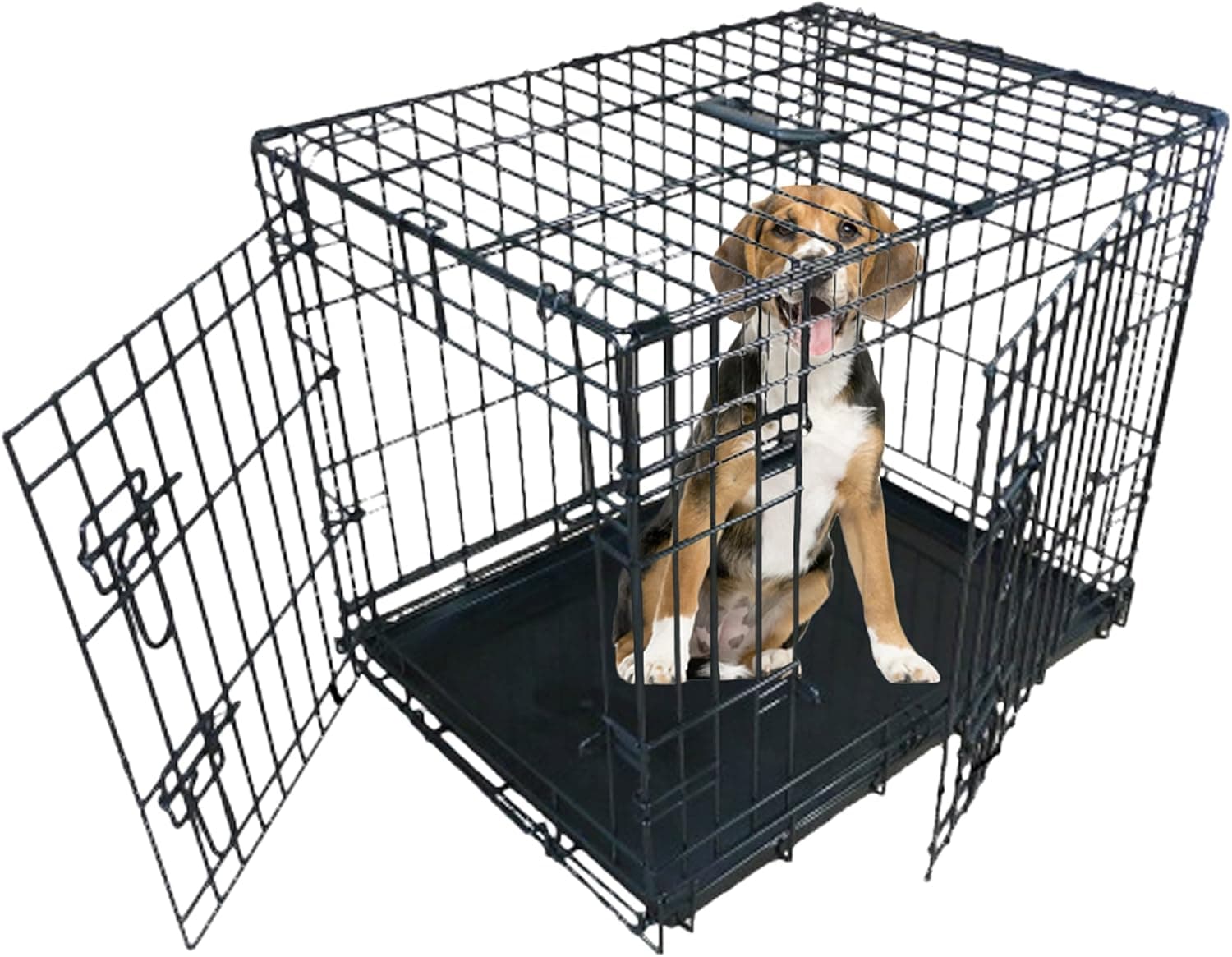
Broadest size choice: Ellie-Bo Standard Dog Cage range—five published sizes from 61 × 46 × 51cm to 122 × 79 × 86.5cm, two doors and a removable steel tray. The Amazon button is an exact-name range search so you must choose the size.
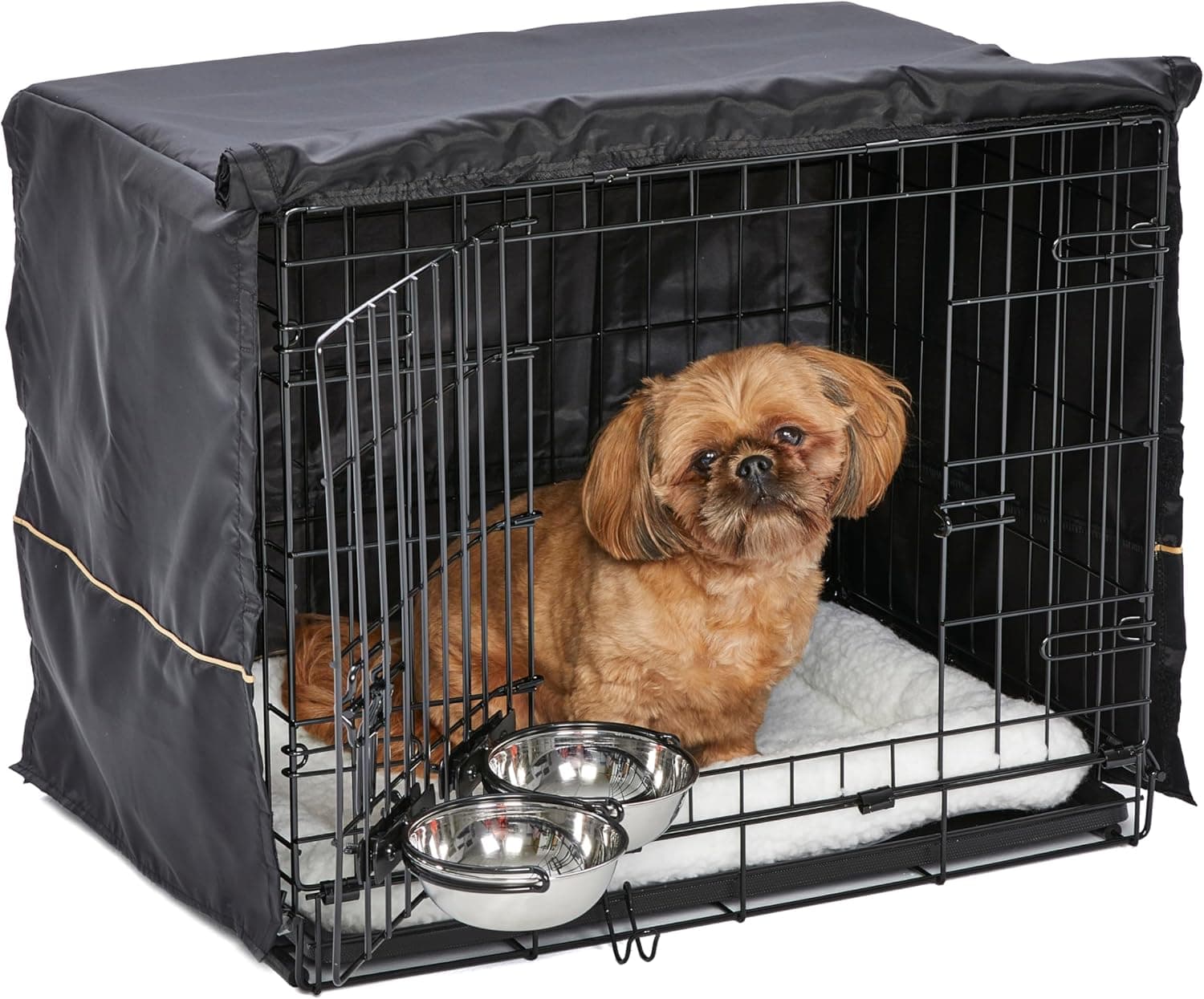
Small-puppy bundle: MidWest iCrate Double Door Starter Kit, 61cm—current exact UK ASIN with crate, divider panel, bed, cover and two bowls. Buy only if its usable space still suits the puppy’s predicted adult size after the divider is positioned.
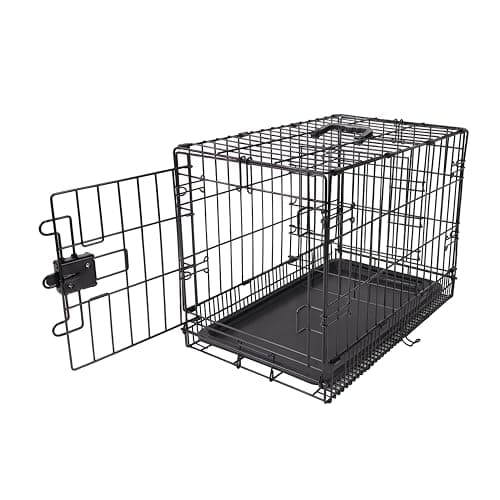
Small metal alternative: Amazon Basics 61cm single-door crate—current exact in-stock ASIN with a tray. It is a small model, so confirm the usable internal space rather than buying from the 24-inch label alone.
Do not buy yet: if you cannot estimate adult size or the puppy shows distress in confinement, ask the breeder, vet or a qualified behaviour professional before relying on a crate purchase.
Puppy crate comparison: size route and main limit
The two 61cm direct ASINs are small models, not generic answers for every puppy. Choose by measured adult fit first; door count and bundle extras come later.
Current route
Published size or range
What is included
Main limit
Ellie-Bo Standard Dog Cage range
S 61cm through XXL 122cm; five official sizes
Two-door steel cage, removable steel tray and handle
No divider appears in the official included-items list; Amazon search requires size selection
MidWest iCrate Double Door Starter Kit
Exact Amazon route: 61cm kit
Double-door crate, divider panel, fleece bed, cover and two clip-on bowls
Published dimensions are not usable internal clearance; verify the received parts and adult fit
Amazon Basics Small Metal Dog Crate
Exact Amazon route: 61cm (24-inch) small model
Single-door foldable metal cage with tray
Small size only; verify usable internal dimensions, included parts and adult fit
What actually matters here
Adult-size fit first: enough height to stand and sit, and enough floor area to turn, lie naturally, wag and stretch fully.
Water and bedding space: the final setup must leave accessible water and a comfortable resting area.
Exact size behind the button: a range search requires the buyer to choose; a direct ASIN must state its dimensions clearly.
Home-use design versus vehicle travel: do not assume a folding home crate is a crash-tested car restraint.
Training boundary: reward-based introduction at the puppy’s pace; no punishment, forced “cry it out” promise or fixed first-week deadline.
Inspectable condition: check wire, joints, door alignment, latches, tray and sharp edges before every early use and stop if the puppy is distressed or damaging the crate.
Who this is for
Owners choosing a home resting crate after estimating the puppy’s adult dimensions.
Puppies being introduced gradually with the door initially secured open and positive rewards.
Homes that can provide water, comfortable bedding, alternative rest places and regular toilet breaks.
Who should skip
A puppy who cannot stand, turn, lie naturally and stretch fully in the proposed usable area.
A dog showing panting, cowering, excessive barking, aggression or persistent attempts to escape—slow down and seek professional help.
All-day confinement, punishment, separation-anxiety management without professional guidance or unverified car-crash protection.
How to choose the right puppy crate size
PDSA says the dog should stand and sit without touching the top, turn around, lie down, wag and stretch fully, with space for bedding, water, food bowls and toys. Choose from predicted adult size or replace/expand the crate as the puppy grows. Its explicit safeguard is that too big is better than too small.
RSPCA guidance similarly requires room to stand, turn, lie and stretch. Ask the breeder for parental dimensions or measure a similar adult dog; crossbreed labels and projected weight alone are too imprecise for a fixed inch chart.
If using a divider, reassess it frequently. Move or remove it before the puppy loses room to change position, stretch naturally or reach water. A divider is an organisational feature, not permission to make the resting area cramped.
Wire, fabric and travel crates are different purchases
For home use, PDSA describes wire crates as sturdy, ventilated and commonly foldable. It says fabric crates are less durable, harder to clean and unsuitable for puppies or dogs who chew. That does not make every wire cage equally safe: inspect the exact frame, tray and door and stop using damaged equipment.
A home crate is not automatically a vehicle restraint. RSPCA notes that an adult-size home crate may be too large for puppy travel. Use a transport setup suited to the vehicle, puppy and journey rather than treating any fold-flat metal cage as crash-tested.
A reward-based introduction, not a seven-day promise
Secure the door open at first, let the puppy investigate voluntarily and reward calm entry. Blue Cross recommends leaving the door open until the puppy is comfortable, then closing it for only a few seconds and building duration gradually.
PDSA says crate training usually takes at least a few weeks and can take much longer. The old day-by-day schedule and claim that crying usually resolves within two or three nights were removed because individual progress cannot be promised.
RSPCA says panting, excessive barking, cowering or aggression can mean the duration increased too quickly. Go back a step. A crate should never be punishment or an all-day solution, and it should not be used to manage separation anxiety without professional guidance.
Water, bedding, covers and location
Provide accessible water. PDSA says dogs should always have water in the crate; RSPCA suggests a clip-on bowl to reduce tipping. Use comfortable bedding only while it remains intact and safe for the individual puppy.
Place the crate in a quiet, draught-free area out of direct sunlight, where the puppy can still feel part of the household. A cover over the top and sides can reduce noise and draughts, but keep the front open and maintain airflow and temperature.
What puppy owners keep asking
Recent puppy-community discussions repeatedly asked whether a divider was making the crate too small, how to distinguish adjustment from distress, whether to move the crate near the owner at night, and what to do about crying or accidents. These discussions were used to find questions, not to prove a product or training result.
The evidence-led answer is not a universal “ignore the crying” rule. Check toilet needs and physical comfort, watch for the RSPCA distress signs, reduce the training step when needed and ask a vet or qualified behaviourist if the puppy is not progressing.
The former fixed prices, review counts, latch-noise, wire-gauge, breed-capacity, training-duration, “safest crate” and crash-test claims were not supported by current evidence and were removed. No crate has been hands-on tested by Dog Product Reviews.
Quick questions before you buy
What size crate should I buy for a puppy?
Choose for predicted adult dimensions or increase the crate as the puppy grows. PDSA says the dog must stand and sit without touching the top, turn, lie naturally, wag and stretch fully, with room for bedding and water. Too big is better than too small.
Does a puppy crate need a divider?
Not every crate includes or needs one. A divider can organise an adult-size crate while a puppy grows, but it must never prevent natural stretching, position changes or water access. Check the exact included-parts list and reassess the usable space frequently.
Broadest manufacturer-listed range among these shortlisted options
The official included-items list names the cage, tray and handle, not a divider. Check the selected Amazon listing, internal dimensions and included equipment before purchase; the published range dimensions are not a breed chart.
Best exact small-size bundle when 61cm fits the predicted adult dog
This affiliate route is specifically the 61cm kit. No checked source publishes its usable internal clearance, and a divider reduces the available area, so verify the received parts and confirm standing, turning, lying, stretching, bedding and water space before use.
The route is one small size and the current title does not identify a divider. Inspect the live dimensions, included-parts section, door alignment and latches rather than assuming the 24-inch label suits the puppy.
Current price varies
Recommended picks
Broad size range to compare after fit checks
Best for: Broadest manufacturer-listed range among these shortlisted options
Ellie-Bo Standard Dog Cage range
Why it made the list:Ellie-Bo’s current specification publishes five sizes: 61 × 46 × 51cm, 76 × 53.5 × 60cm, 91.5 × 61 × 66cm, 107 × 71 × 79cm and 122 × 79 × 86.5cm. It also lists two doors, L-shaped latches, a fold-flat frame, removable steel tray and handle. The Amazon affiliate route is an exact-name search so the owner can choose the measured size rather than being forced into the old 61cm ASIN.
Main drawback: The official included-items list names the cage, tray and handle, not a divider. Check the selected Amazon listing, internal dimensions and included equipment before purchase; the published range dimensions are not a breed chart.
Typical price band: Current price varies by size
Pros
Five official size options from 61cm to 122cm.
Two doors and a removable steel tray are stated by the manufacturer.
Range search keeps size choice visible before purchase.
Cons
No divider appears in the official included-items list.
Amazon search results can mix sizes and colours.
Assembly, latch security, tray leakage and long-term durability are untested here.
MidWest iCrate Double Door Starter Kit, 61cm — best exact small-size bundle when 61cm fits the predicted adult dog
Amazon Basics Small Metal Dog Crate 61cm, Single Door — small exact single-door metal-crate alternative
Best for: Best exact small-size bundle when 61cm fits the predicted adult dog
MidWest iCrate Double Door Starter Kit, 61cm
Why it made the list: The current exact ASIN is the 61cm Double Door iCrate Starter Kit. MidWest’s official kit page lists a double-door iCrate, QuietTime fleece bed, crate cover and two Snap’y Fit food and water bowls. MidWest’s current iCrate assembly instructions identify a divider panel with the crate; Amazon’s exact 61cm offer also lists the divider among the iCrate components.
Main drawback: This affiliate route is specifically the 61cm kit. No checked source publishes its usable internal clearance, and a divider reduces the available area, so verify the received parts and confirm standing, turning, lying, stretching, bedding and water space before use.
Typical price band: Current price varies
Pros
Exact current 61cm UK ASIN.
Published bundle includes a divider, bed, cover and two clip-on bowls.
Two-door format can help room placement.
Cons
A 61cm crate is not suitable for every puppy’s adult size.
Usable internal clearance is not published in the checked sources.
Bedding comfort, bowl fit, latch noise and durability are untested here.
Amazon Basics Small Metal Dog Crate 61cm, Single Door — small exact single-door metal-crate alternative
Ellie-Bo Standard Dog Cage range — broadest manufacturer-listed range among these shortlisted options
Best for: Small exact single-door metal-crate alternative
Amazon Basics Small Metal Dog Crate 61cm, Single Door
Why it made the list: Amazon’s current Creators API title identifies this exact ASIN as the 61cm (24-inch) small model with a single door and tray, and describes it as foldable. Those are current listing facts, not an independent quality or escape-resistance test.
Main drawback: The route is one small size and the current title does not identify a divider. Inspect the live dimensions, included-parts section, door alignment and latches rather than assuming the 24-inch label suits the puppy.
Typical price band: Current price varies
Pros
Exact current 61cm small-model route.
Current title specifies a single door, tray and foldable frame.
Direct ASIN passed the current stock and title audit.
Cons
Only the 61cm model is linked.
Divider inclusion is not stated in the current API title.
Wire gauge, edge finish, latch security and durability are untested here.
Choose for predicted adult dimensions or increase the crate as the puppy grows. PDSA says the dog must stand and sit without touching the top, turn, lie naturally, wag and stretch fully, with room for bedding and water. Too big is better than too small.
Does a puppy crate need a divider?
Not every crate includes or needs one. A divider can organise an adult-size crate while a puppy grows, but it must never prevent natural stretching, position changes or water access. Check the exact included-parts list and reassess the usable space frequently.
How long can a puppy be left in a crate?
There is no safe age-plus-one formula for every puppy. PDSA says never leave a dog in a crate for more than three hours and notes some tolerate less; puppies need more frequent toilet breaks and gradual training. Never use a crate for an entire workday.
What should I do if my puppy cries in the crate?
Check toilet needs, temperature, size and physical comfort. If the puppy pants, cowers, barks excessively, becomes aggressive or tries persistently to escape, RSPCA says the step may have progressed too quickly. Reduce duration and seek professional help if it continues.
Is a wire or fabric crate better for a puppy?
PDSA describes wire crates as sturdy and well ventilated and says fabric crates are generally unsuitable for puppies or dogs who chew. Inspect any crate for damage and do not assume a home crate is safe for vehicle travel.
Should a puppy have water in the crate?
Yes. PDSA says dogs should always have access to water in the crate. RSPCA suggests a clip-on bowl to reduce spills. Ensure the chosen crate leaves enough room for both water and comfortable bedding.
Should I cover a puppy crate?
A cover over the top and sides may reduce noise and draughts, but leave the front open, maintain airflow and monitor temperature and the puppy’s response. Do not use a cover to ignore distress.
Can I use a puppy crate as punishment?
No. PDSA, RSPCA and Blue Cross all describe the crate as a positive safe space. Never use it as punishment, to stop unwanted behaviour or as a substitute for separation-anxiety treatment.
Broad size range to compare after fit checksEllie-Bo Standard Dog Cage range