Affiliate disclosure: Some links below are affiliate links. If you buy through one, Dog Product Reviews earns a commission at no extra cost to you. As an Amazon Associate I earn from qualifying purchases. Full disclosure.
Evidence: research-led. Dog Product Reviews has not crate-tested, chew-tested, washed or durability-tested these beds. One fixed product is source-locked to its current model, dimensions and maker care; the other two are retailer-search routes whose exact materials, dimensions and care label must be verified by the buyer. Supervise use and remove damaged bedding. How we assess products.
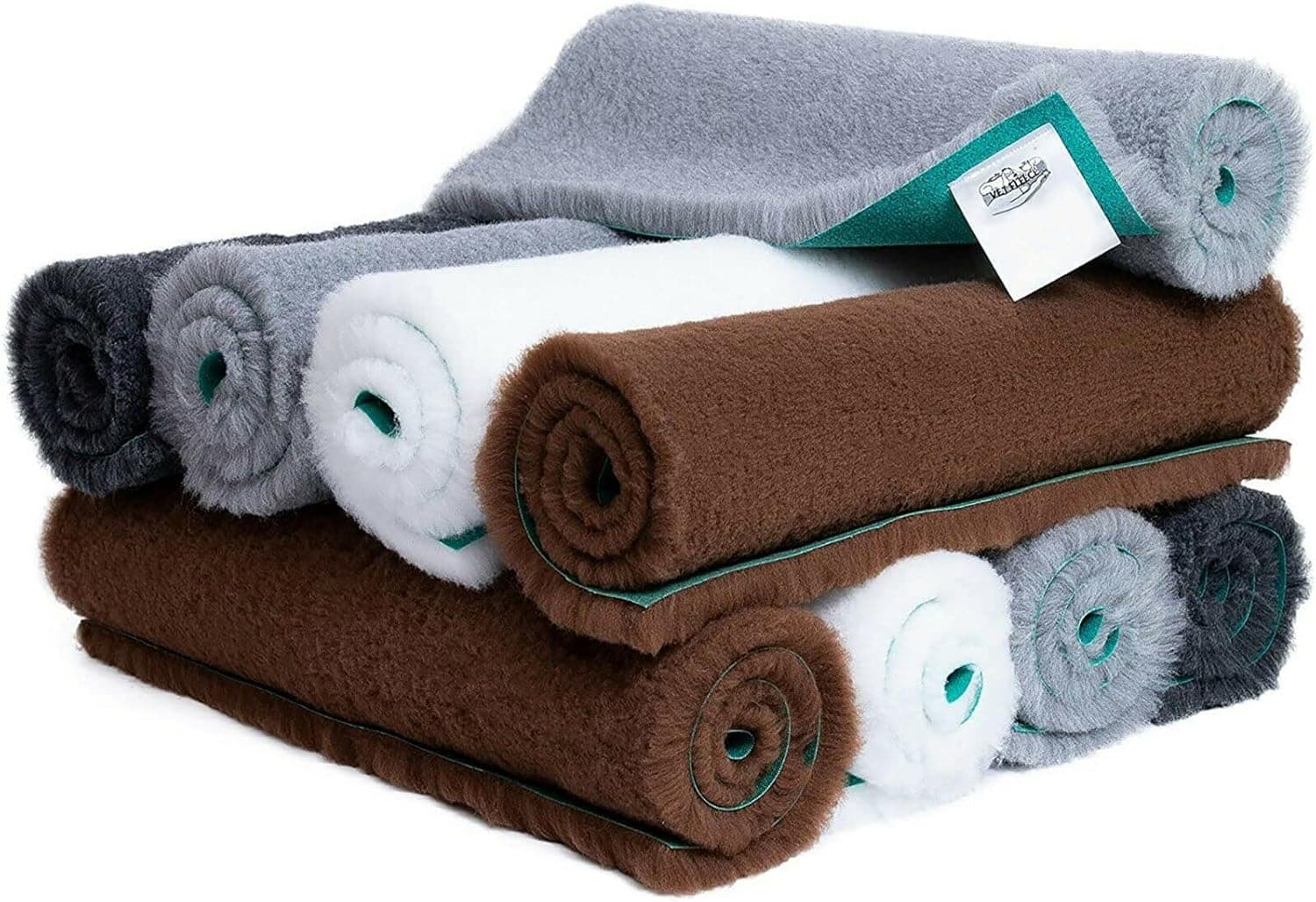
Vetfleece Original Greenback Fleece — 40 × 30in, Charcoal
Flat, washable puppy bedding where 100 × 75cm fits the measured space.
Evidence: research-led
Main drawback: This is the greenback version, not the non-slip version. It is not chew-proof; supervise and remove damaged bedding. The fixed Amazon route is 40 × 30in, so measure the crate or sleeping area first.
No puppy bed is chew-proof. The useful first decision is whether the exact sleeping surface fits the measured space, has care instructions the household can follow and can be inspected easily for torn fabric, exposed filling or damaged backing.
The fixed Amazon route on this page is disclosed down to colour and dimensions. The other two are retailer searches, so confirm the exact size, materials and care label before buying rather than transferring claims between variants.
What actually matters here
Exact maker care label, including wash temperature and drying instructions.
Published product dimensions compared with the measured usable sleeping area.
Accessible seams, backing and filling that can be checked before every use.
A flat, stable setup that still leaves the puppy room to change position normally.
A clear stop rule: remove damaged bedding or any material the puppy starts to detach or swallow.
Start with the care label and exact dimensions
Wash temperature and construction belong to the exact product, not the category. The Vetfleece route above is the Original Greenback 40 × 30in model and its current routine-care direction is 40°C; that cannot be transferred to another Vetfleece range or to a generic “vet bed”.
For any search result, record the selected model, dimensions and wash instructions before ordering. Measure the usable sleeping surface rather than assuming a “24-inch” label describes the space left after bolsters or thick edges.
Treat chewing and damage as stop conditions
No fabric, fleece, zip or seam on this page is proven indestructible. Inspect the chosen bed before use, supervise introductions and remove it if the puppy tears the surface, reaches filling or backing, or swallows material.
If a puppy repeatedly eats non-food material, is distressed in the sleeping setup or has swallowed part of a bed, stop using it and seek appropriate veterinary advice rather than trying a stronger marketing label.
Fit the bed without removing necessary space
A bed used in a crate should not prevent the puppy from standing, turning, lying down and changing position normally. Measure the usable crate floor and the actual bed footprint; raised sides and thick padding reduce the remaining space.
The product route should also leave a practical way to remove, wash and dry the bedding according to its own label. Do not infer that a backing is non-slip, waterproof or safe to cut unless the exact maker says so.
Quick questions before you buy
What size bed does my puppy need?
Measure the usable sleeping area and the puppy lying in a normal stretched position. A crate bed must still leave room to stand, turn, lie down and change position; compare the actual bed footprint, not a nominal crate-size label.
How often should I wash a puppy bed?
Follow the exact care label and wash sooner after soiling. Do not apply one temperature to every bed: the fixed Vetfleece Original Greenback route on this page currently specifies 40°C for routine care.
Flat, washable puppy bedding where 100 × 75cm fits the measured space
This is the greenback version, not the non-slip version. It is not chew-proof; supervise and remove damaged bedding. The fixed Amazon route is 40 × 30in, so measure the crate or sleeping area first.
A retailer-search route for owners comparing a bolster format
Soft sides, seams and filling can become hazards if damaged. No age makes a fabric bed chew-proof; supervise the individual puppy and remove the bed if material is being detached.
A retailer-search route for comparing a box-bed format against measured crate space
A nominal crate size does not prove usable fit, and raised sides reduce the sleeping surface. Dog Product Reviews has not washed, measured or durability-tested the selected variant.
££
Recommended picks
Top pick
Best for: Flat, washable puppy bedding where 100 × 75cm fits the measured space
Vetfleece Original Greenback Fleece — 40 × 30in, Charcoal£
Why it made the list: The linked Amazon item is a 40 × 30in (100 × 75cm) charcoal piece of Original Greenback Fleece, model VF-4030-CH. Vetfleece says its 25–28mm pile lets liquid pass through, its double-woven green backing is washable at 40°C for routine care, and it can be cut to fit without fraying.
Main drawback: This is the greenback version, not the non-slip version. It is not chew-proof; supervise and remove damaged bedding. The fixed Amazon route is 40 × 30in, so measure the crate or sleeping area first.
Typical price band: £
Pros
Exact charcoal 40 × 30in model disclosed.
Maker-published routine wash at 40°C.
Pile is designed to let moisture pass through.
Maker says the material can be cut without fraying.
Cons
Greenback is not the non-slip range.
Not chew-proof.
Fixed 100 × 75cm route must be measured against the space.
Snug & Cosy Pet Dog Bed — a retailer-search route for owners comparing a bolster format
Scruffs Expedition Box Bed — a retailer-search route for comparing a box-bed format against measured crate space
Best for: A retailer-search route for owners comparing a bolster format
Snug & Cosy Pet Dog Bed££
Why it made the list: This is an Amazon search rather than a fixed product. Confirm the exact dimensions, cover construction, filling and care label on the item selected; Dog Product Reviews has not verified one current variant as equivalent to another.
Main drawback: Soft sides, seams and filling can become hazards if damaged. No age makes a fabric bed chew-proof; supervise the individual puppy and remove the bed if material is being detached.
Typical price band: ££
Pros
Retailer search exposes current sizes and variants.
Raised-side format can be compared with the puppy’s observed sleeping position.
Cons
Exact variant is not source-locked.
Care and filling claims must be checked on the selected item.
Scruffs Expedition Box Bed — a retailer-search route for comparing a box-bed format against measured crate space
Vetfleece Original Greenback Fleece — 40 × 30in, Charcoal — flat, washable puppy bedding where 100 × 75cm fits the measured space
Best for: A retailer-search route for comparing a box-bed format against measured crate space
Scruffs Expedition Box Bed££
Why it made the list: The search can contain several Expedition sizes and colours. Select only after confirming the exact outer dimensions, internal sleeping surface, care label and current product identity at the retailer.
Main drawback: A nominal crate size does not prove usable fit, and raised sides reduce the sleeping surface. Dog Product Reviews has not washed, measured or durability-tested the selected variant.
Typical price band: ££
Pros
Retailer search exposes current size choices.
Box-bed format can be compared with a measured sleeping footprint.
Measure the usable sleeping area and the puppy lying in a normal stretched position. A crate bed must still leave room to stand, turn, lie down and change position; compare the actual bed footprint, not a nominal crate-size label.
How often should I wash a puppy bed?
Follow the exact care label and wash sooner after soiling. Do not apply one temperature to every bed: the fixed Vetfleece Original Greenback route on this page currently specifies 40°C for routine care.
My puppy keeps chewing their bed. What should I do?
Remove damaged bedding and anything the puppy is detaching or swallowing. No option here is chew-proof. Repeated eating of non-food material or suspected ingestion needs appropriate veterinary advice.
Is it worth buying an expensive puppy bed?
Price does not prove fit, washability or durability. Start with the measured sleeping area, exact care label, damage risk and returns route; Dog Product Reviews has not run a value or longevity test on these beds.
What is the best type of bed for a puppy?
There is no universal type. Compare a flat fleece with a bolster or box format using the individual puppy’s sleeping position, measured space, exact care label and behaviour around seams and filling.
Does Vetfleece Original Greenback have a non-slip backing?
No. The linked item is the Original Greenback range, not Vetfleece’s separate non-slip range. Use it only on a stable surface and inspect the fit and backing in the intended space.
What to buy alongside
Optional extras that may help with the task on this page. Check size, compatibility and care instructions before buying; these are category searches, not products tested by Dog Product Reviews.
Reusable puppy training pads
A separate washable surface can simplify accident cleanup; compare exact dimensions, absorbency instructions and wash care.