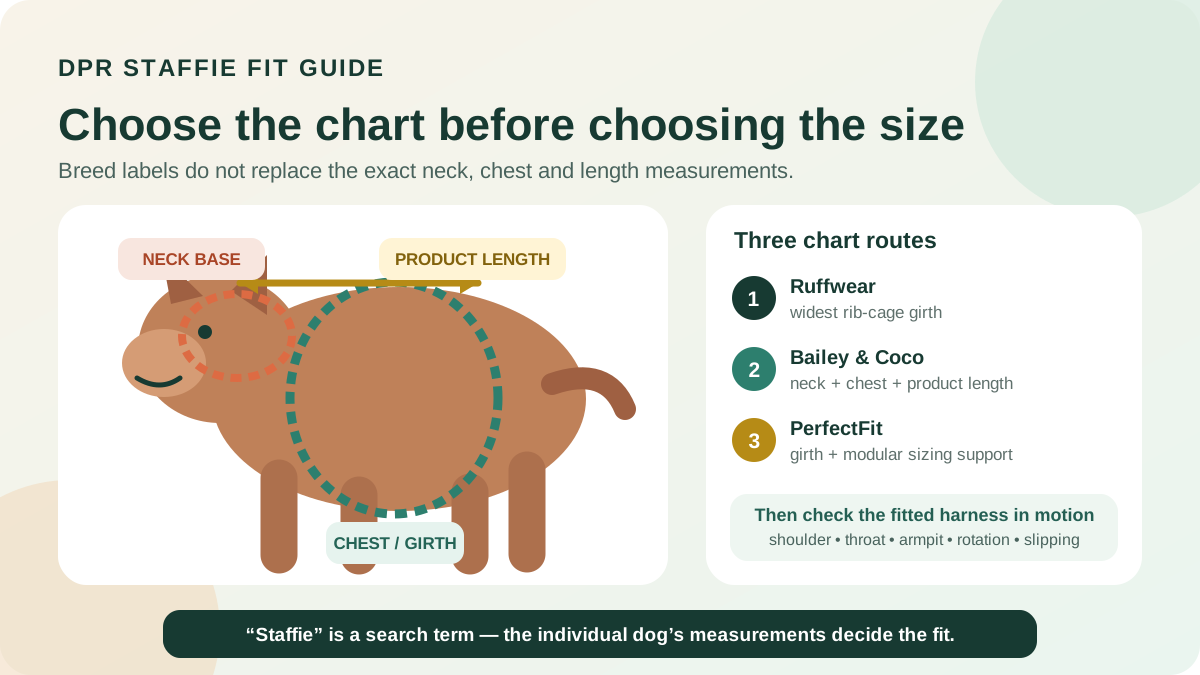
Compare exact Staffie harness routes by neck, chest and length measurements, adjustment, entry style and attachment points, with no universal size or anti-pull claim.
Affiliate disclosure: Some links below are affiliate links. If you buy through one, Dog Product Reviews earns a commission at no extra cost to you. As an Amazon Associate I earn from qualifying purchases. Full disclosure.
Evidence: research-led. Dog Product Reviews has not fitted these harnesses to a Staffordshire Bull Terrier, measured movement, attempted a reverse-out, tested rubbing, pulling, buckle strength, wear or washing. On 31 July 2026 we compared current maker measurement systems and construction with Royal Kennel Club breed terminology and Dogs Trust fit guidance. Recent owner discussions were used only to identify questions, not to prove fit or performance. How we assess products.
A current, size-neutral Amazon route with clear maker specifications.
Evidence: research-led
Main drawback: Ruffwear does not describe Front Range as Staffie-specific, and girth alone cannot establish neck opening, body length, shoulder clearance or the finished fit.
Skip if: Anyone expecting a Staffie label, weight or fixed Small/Medium/Large recommendation to guarantee fit.
There is no universal Staffie harness size. The Royal Kennel Club standard describes an ideal wide front, deep brisket, well-sprung ribs and a muscular neck that widens towards the shoulders, but explicitly warns that an individual dog can be larger or smaller than the standard. Measure the dog and the exact harness route rather than translating those words into Medium or Large.
This guide compares three current measurement systems: Ruffwear’s widest-rib-cage chart, Bailey & Coco’s neck/chest/length chart, and PerfectFit’s girth-led modular route. They answer different fit problems; none has been independently fitted by Dog Product Reviews.
Only the Ruffwear Amazon route earns DPR a commission. The two direct-retailer alternatives are included because a truthful comparison is more useful than forcing every buyer through the one earning option.
Quick answer:
Best-documented Amazon route: Ruffwear Front Range. It publishes four adjustment points, front and back lead connections and a widest-rib-cage chart. Choose no size until the dog is measured.
More dimensions on a fixed harness: Bailey & Coco Trail & Glow publishes neck, chest and product length bands plus a neck clip. Its breed suggestions are guidelines, not a Staffie size result.
Modular route: PerfectFit Staffordshire Bull Terrier Harness publishes five adjustment points, a neck buckle and replaceable pieces, with sizing support for unusual or between-size results.
Fit still decides: Dogs Trust says the harness should avoid crossing the shoulders, allow one comfortable finger, stay positioned in movement and not let the dog slip out.
Staffie harness comparison: measurements before marketing
These rows reproduce current maker specifications and limits. They are not Dog Product Reviews fit, comfort or pulling tests.
Current route
What the maker measures
Construction to compare
Main limit
Ruffwear Front Range
Girth around the widest part of the rib cage; five bands cover 33–107 cm; maker says choose the larger size between ranges.
Four adjustment points; aluminium back V-ring and reinforced chest webbing.
A girth-only chart cannot prove neck opening, body length, shoulder clearance or Staffie-specific fit.
Bailey & Coco Trail & Glow
Neck at the base, chest at the widest point and a listed product length for each size.
Three-buckle design that clips around the neck; front/back D-rings, handle and reflective strips.
Breed suggestions are maker guidelines and live availability is size-dependent; measure rather than selecting “Staffy”.
PerfectFit Staffordshire Bull Terrier Harness
Snug girth just behind the front legs; current preset lists a 53–63 cm full adjustment range; sizing team handles unusual results.
Three modular pieces, five adjustment points, neck buckle, replaceable pieces and top/front D-rings.
The preset is not a breed-wide size and its front D-ring must be paired with the back ring.
What actually matters here
Open the exact product and current chart before measuring; “girth” is not defined at one universal body line.
Use every required measurement, including neck or product length when the chosen maker publishes it.
Check shoulder, throat and armpit clearance while the dog stands, walks, turns, sits and lowers the head.
Reject a harness that rotates, gaps, rubs, restricts movement or starts to slip when the dog changes direction.
Choose over-head or neck-clipping entry according to the individual dog’s handling response, not a breed assumption.
Confirm current size availability and unused-return conditions before personalising, removing tags or walking outdoors.
Who this is for
Staffie owners comparing one-dimensional, multi-dimensional and modular fit routes.
Growing dogs or adults whose neck and chest measurements land in different chart bands.
Dogs whose current harness shifts, enters the armpit, rubs when wet or feels difficult to put on.
Who should skip
Anyone expecting a Staffie label, weight or fixed Small/Medium/Large recommendation to guarantee fit.
Anyone expecting a front ring or “anti-pull” product name to replace reward-based loose-lead training.
Dogs with pain, skin injury, breathing change, gait change or distress around handling without veterinary or qualified professional advice.
Why Staffie is not a harness size
The Royal Kennel Club’s ideal description helps explain why buyers often compare neck, chest and shoulder fit, but it is not a retail chart. Even its listed height and weight come with a warning that an individual dog may be larger or smaller.
Use the exact dog’s measurements and the exact product chart. Do not assume that an old Medium in one brand transfers to another, that a Staffie suggestion is a guarantee, or that the same dog will stay in one band while growing or changing body condition.
Choose the measurement system before the size
Ruffwear asks for the widest rib-cage girth and gives Front Range a model-specific between-size rule. Bailey & Coco asks for neck and chest and publishes a product length. PerfectFit begins with a snug girth just behind the front legs and can change individual modular pieces.
If neck and chest sit in different bands, a fixed harness may be the wrong geometry even if one number fits. If the dog is still growing or the result is close, remeasure and use the maker’s support rather than buying deliberate looseness as “growth room”.
Ruffwear Front Range: what the Amazon route can and cannot prove
The current Front Range page documents four adjustment points, back and chest lead connections and a widest-rib-cage chart spanning 33–107 cm. The exact-name Amazon search lets the buyer choose the measured variant instead of opening the former hard-coded Medium query.
Those facts do not prove a Staffie fit, pulling reduction, comfort or durability. Check the neck opening, chest panel, shoulder clearance and armpit position on the dog after adjustment.
Bailey & Coco: three published dimensions
The Trail & Glow chart publishes neck, chest and product length figures and labels its breed examples as guidance only. Its current construction includes a neck clip, two body buckles, front and back D-rings, a handle and reflective strips.
Treat “no pull”, “secure”, “strength-tested” and comfort wording as seller claims rather than DPR findings. The page’s selected-size stock messaging can change, so confirm the required size is actually purchasable before relying on the route.
PerfectFit: modular fit with a product-specific front-ring rule
The current Staffie page lists a 20 mm three-piece preset with a 53–63 cm full adjustment range, five adjustment points, a neck buckle and replaceable pieces. PerfectFit asks mixed, growing, between-size or unusually shaped dogs to contact its sizing team with girth and photographs.
PerfectFit says its harness is not an anti-pull tool. It also says the front D-ring must be used with the back ring and a double-ended lead, never alone. Do not transfer another brand’s front-clip instructions to it.
Fit-check the harness while the dog moves
Dogs Trust advises avoiding designs that cross directly in front of the shoulders, allowing one finger comfortably beneath the straps, ensuring the harness stays positioned during movement and confirming the dog cannot slip out.
Try the harness indoors with tags attached. Watch the dog stand, walk, turn, sit and lower the head. Stop for rotation, gaping, rubbing, armpit contact, restricted movement, coughing, distress or the beginning of a reverse-out. Check again after wet walks, growth, coat or body-condition change and strap settling.
Pulling and escape history are separate decisions
A front connection may change steering, but it does not teach loose-lead walking. Use the exact maker’s attachment instructions and pair equipment with reward-based training rather than promising that a harness stops pulling.
If the dog has previously backed out of equipment, use the escape-resistant harness guide to assess a third body strap and collar-to-harness backup. Dogs Trust describes both as options that can add security, not guarantees.
Questions current Staffie owners are asking
Recent discussions ask what happens when neck and chest fall in different bands, how quickly a puppy outgrows a personalised harness, why wet webbing can chafe, whether a front or back ring is appropriate and what to do after a rescue dog reverses out. The puppy sizing thread, walking setup thread and reverse-out thread shaped those questions; they are anecdotes, not product evidence. A read-only X search found no usable Staffie-harness evidence.
What this rebuild removed
The former page mixed a fixed-size Ruffwear affiliate link with a Julius-K9 recommendation, plus unrelated bed, grooming and chew cards. It also made unsupported pulling-force, temperature, medical, temperament and perception claims. Those do not answer the dominant harness intent and have been removed.
This canonical now owns Staffie-specific chart comparison and fit questions. The main harness hub owns the broader market, the no-pull guide owns pulling-product comparison, and the measurement guide owns cross-brand measuring rules.
Quick questions before you buy
What size harness does a Staffie need?
There is no reliable breed-wide size. Ruffwear uses widest-rib-cage girth, Bailey & Coco uses neck and chest plus a product length, and PerfectFit uses girth with modular sizing support. Follow the exact current chart and check the finished fit in movement.
Is Ruffwear Front Range the best harness for every Staffie?
No. It is the best-documented Amazon route here because the current maker publishes clear adjustment, attachment and girth information. DPR has not fitted it to a Staffie, and the individual dog’s measurements and observed fit decide suitability.
A current, size-neutral Amazon route with clear maker specifications
Ruffwear does not describe Front Range as Staffie-specific, and girth alone cannot establish neck opening, body length, shoulder clearance or the finished fit.
Neck, chest and product-length comparison with neck-clipping entry
The seller’s no-pull, security, strength and comfort language is not independent evidence. The rendered page can show different availability by selected size, so stock must be checked at purchase.
The current preset range is a starting point, not a breed-wide recommendation. DPR has not tested the fit, and PerfectFit says its front D-ring must never be used alone.
££
Recommended picks
Best-documented Amazon route
Best for: A current, size-neutral Amazon route with clear maker specifications
Ruffwear Front Range Dog Harness
Why it made the list:Ruffwear’s current Front Range page publishes four adjustment points, an aluminium back V-ring, reinforced chest webbing and a 33–107 cm widest-rib-cage chart. It says to choose the larger size when between bands. The affiliate destination searches the exact product name without forcing a Staffie size.
Main drawback: Ruffwear does not describe Front Range as Staffie-specific, and girth alone cannot establish neck opening, body length, shoulder clearance or the finished fit.
Pros
Four adjustment points are stated by the current maker page.
Both back and chest lead connections are documented.
Exact-name, size-neutral Amazon search avoids the former fixed-size mismatch.
Cons
Only one body measurement drives the chart.
No Staffie-specific fit or performance evidence was found.
DPR has not tested pulling, rubbing, security or durability.
Bailey & Coco Trail & Glow Dog Harness – The Khaki One — neck, chest and product-length comparison with neck-clipping entry
PerfectFit Staffordshire Bull Terrier Harness — modular pieces and direct sizing support
Best for: Neck, chest and product-length comparison with neck-clipping entry
Bailey & Coco Trail & Glow Dog Harness – The Khaki One££
Why it made the list:Bailey & Coco’s current page publishes neck, chest and length figures for each size, a three-buckle layout that clips around the neck, front and back D-rings, a handle and reflective strips. It says breed suggestions are guidelines and individual dogs must be measured.
Main drawback: The seller’s no-pull, security, strength and comfort language is not independent evidence. The rendered page can show different availability by selected size, so stock must be checked at purchase.
Relative budget: ££. Check the retailer for the current price.
Pros
Neck and chest bands plus product length are published.
The neck clip avoids over-head entry.
Direct UK retailer route is clearly non-affiliate.
Cons
Breed suggestions cannot select the size.
No independent fit, pulling, security or wear result was found.
PerfectFit Staffordshire Bull Terrier Harness — modular pieces and direct sizing support
Ruffwear Front Range Dog Harness — a current, size-neutral Amazon route with clear maker specifications
Best for: Modular pieces and direct sizing support
PerfectFit Staffordshire Bull Terrier Harness££
Why it made the list:PerfectFit’s current Staffie route publishes a three-piece preset, five adjustment points, a neck buckle, replaceable pieces, top/front D-rings and sizing-team support for mixed, growing, between-size or unusually shaped dogs.
Main drawback: The current preset range is a starting point, not a breed-wide recommendation. DPR has not tested the fit, and [PerfectFit says](https://perfect-fit-dog-harness.com/pages/faqs) its front D-ring must never be used alone.
Relative budget: ££. Check the retailer for the current price.
Pros
Five adjustment points are stated by the maker.
Individual modular pieces can be changed or replaced.
Direct sizing support can review girth and photographs.
Cons
No third body strap behind the rib cage.
Front attachment requires front-and-back connection with a double-ended lead.
There is no reliable breed-wide size. Ruffwear uses widest-rib-cage girth, Bailey & Coco uses neck and chest plus a product length, and PerfectFit uses girth with modular sizing support. Follow the exact current chart and check the finished fit in movement.
Is Ruffwear Front Range the best harness for every Staffie?
No. It is the best-documented Amazon route here because the current maker publishes clear adjustment, attachment and girth information. DPR has not fitted it to a Staffie, and the individual dog’s measurements and observed fit decide suitability.
What if my Staffie’s neck and chest need different sizes?
Do not force one number to fit. A multi-dimensional fixed harness may not match both, while a modular route may allow different pieces. Use the exact maker’s sizing support and retain the unused-return option until the fit is checked.
Does a front-clip harness stop a Staffie pulling?
No attachment point teaches loose-lead walking by itself. Ruffwear publishes chest webbing as a redirection option; PerfectFit requires its front ring to be paired with the back. Follow the exact instructions and use reward-based training.
How tight should a Staffie harness be?
Dogs Trust says one finger should fit comfortably under the straps while the harness stays in position and cannot be slipped. Also check shoulder, throat and armpit clearance during walking and turning.
Should I buy a larger harness for a growing Staffie puppy?
Do not create unsafe looseness as growth room. Measure against the exact current chart, recheck frequently and use maker support or an exchangeable route. Personalisation can change return rights, so confirm those terms first.
Is a three-strap harness necessary for every Staffie?
No. Dogs Trust says a three-strap design can help some dogs that wriggle free. Use escape history and the individual fit rather than breed name, and consider a collar-to-harness backup for a dog that has previously slipped equipment.
Fit and conditional backup items
Optional extras that may help with the task on this page. Check size, compatibility and care instructions before buying; these are category searches, not products tested by Dog Product Reviews.
Soft metric body tape
Take the exact neck, chest, girth or product-length comparison required by the chosen maker.