Best Greyhound Harness UK 2026: Fit & Security Guide
Compare two research-led Greyhound harness routes by chest, waist, body length, entry style and backup checks. No universal size or escape-proof claim.
Affiliate disclosure: Some links below are affiliate links. If you buy through one, Dog Product Reviews earns a commission at no extra cost to you. As an Amazon Associate I earn from qualifying purchases. Full disclosure.
Evidence: research-led. Dog Product Reviews has not fitted either harness to a Greyhound, measured strap position in movement, attempted a reverse-out, tested rubbing, pulling, wear, washing or buckle strength. On 31 July 2026 we compared current maker dimensions with Royal Kennel Club anatomy terminology, Dogs Trust fit and security guidance and Greyhound Trust handover and long-line guidance. Owner discussions identified questions only; they are not product evidence. How we assess products.
GreatHounds Triple Strap Adjustable Y Harness in Grey
Buyers willing to confirm approximate product geometry with the seller.
Evidence: research-led
Main drawback: It is one published geometry and goes over the head. The maker does not publish a dog-measurement protocol for the fixed lengths, and GreatHounds itself says no harness is completely escape-proof.
Skip if: Anyone expecting “Greyhound”, Medium, Large or a weight band to guarantee fit.
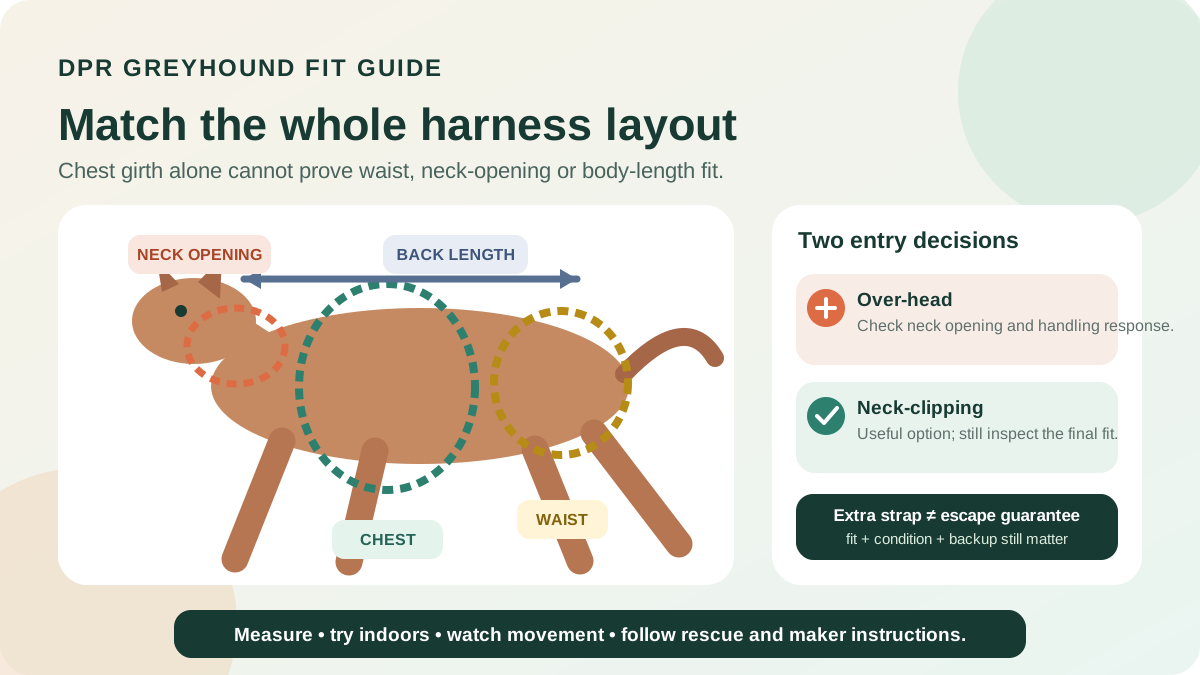
A Greyhound harness has to match more than one circumference. The Royal Kennel Club standard describes a long neck, well-laid shoulders, a deep chest, ribs carried well back and cut-up flanks, while warning that an individual dog may sit outside its ideal measurements. That makes chest, waist, body length and strap position more useful than a breed label.
This guide compares two current UK direct routes with different geometry: a three-body-strap harness with approximate fixed product lengths plus adjustable chest and waist ranges, and a modular neck-clipping harness. Both links are non-affiliate. We have not found a Greyhound-specific Amazon harness route that we can verify strongly enough to force into the shortlist.
If the dog is newly homed, begin with the equipment and instructions supplied by the rescue. Greyhound Trust says it provides a collar, lead and muzzle and asks adopters to use individual branch guidance. A new online guide should not override that handover.
Quick answer:
Measure the whole layout: chest, waist, neck opening and back or joiner length can disagree even when one girth number fits.
More fully dimensioned of the two reviewed routes: GreatHounds Triple Strap Adjustable Y Harness. Ask the seller how its approximate product dimensions should map to the dog, then verify the finished fit.
Modular, non-over-head route: PerfectFit Greyhound Harness. The current preset clips around the neck and has replaceable pieces; use its sizing support for a growing, mixed, between-size or unusually shaped dog.
No escape-proof promise: Dogs Trust says a three-strap harness can help some dogs, but fit, condition, handling and a collar-to-harness backup remain part of the security plan.
Greyhound harness comparison: two different fit routes
Specifications below come from the current sellers. They are not Dog Product Reviews fit, comfort or security results.
Current route
Published dimensions
Entry and lead points
Decision limit
GreatHounds Triple Strap Adjustable Y Harness
Approx. 46 cm neck opening, 36 cm back, 22 cm neck-to-chest joiner, 60–78 cm chest and 36–64 cm waist.
Over-head entry; locking chest and waist clasps; front and back D-rings.
One published layout with approximate fixed lengths and adjustable chest/waist ranges. Confirm how the geometry should map to the dog; the seller says no harness is completely escape-proof.
PerfectFit Greyhound Harness
Current 20 mm L-M-L preset lists a 64–74 cm full adjustment range; sizing support can recommend different modular pieces.
Neck buckle avoids over-head entry; five adjustment points; top and front D-rings.
The front D-ring must be paired with the back ring. The preset is not a breed-wide size guarantee.
What actually matters here
Follow each maker’s dog-measurement method. Where only approximate product dimensions are published, ask the seller how to map them instead of treating them as exact body measurements.
Check where the chest and rear body straps sit while the dog stands, walks, turns, sits and lowers the head.
Reject a fit that crosses the front of the shoulders, enters the armpit, rotates, rubs, restricts movement or begins to slip.
Choose over-head or neck-clipping entry according to the individual dog’s handling comfort and the maker’s instructions.
For previous escape history, consider a three-body-strap layout and a separate collar-to-harness backup without calling either infallible.
Confirm the current seller’s stock and unused-return rules before removing tags or using the harness outdoors.
Who this is for
Greyhound owners comparing a three-strap route with more published product geometry against a modular neck-clipping route.
New adopters who want to check a purchase against their rescue’s supplied equipment and advice.
Dogs whose current harness rotates, gaps, enters the armpit or feels difficult to put over the head.
Who should skip
Anyone expecting “Greyhound”, Medium, Large or a weight band to guarantee fit.
Anyone seeking a universally escape-proof harness; no product removes every fit, behaviour or handling risk.
Dogs with pain, skin injury, mobility limitations or distress around handling without veterinary or qualified professional advice.
Why one Greyhound measurement is not enough
The Royal Kennel Club’s deep-chest, ribs-carried-back and cut-up-flank description explains why the rear strap position matters as well as chest girth. It does not prove that every Greyhound has identical proportions or fits a particular product.
Record the dog measurements requested by the exact maker. GreatHounds publishes approximate harness measurements for the neck opening, back, joiner, chest and waist but no dog-measurement protocol for mapping every value, so ask the seller how the fixed product geometry should relate to the dog. For PerfectFit, take the snug girth at its defined line and use its support route when the preset does not clearly describe the dog.
GreatHounds: five product dimensions to clarify
The current GreatHounds page lists a 46 cm neck opening, 36 cm back, 22 cm joiner, 60–78 cm chest and 36–64 cm waist, all described as approximate product measurements. It also publishes locking clasps, front and back D-rings and an extra rear body strap.
Do not turn “Greyhound-specific” into “fits every Greyhound”. A dog can sit inside the chest band while the waist range, fixed neck opening or body geometry still produces a poor finished fit. The seller says the design is intended to make escape harder but explicitly says no harness is completely escape-proof.
PerfectFit: modular pieces and a neck buckle
PerfectFit’s current Greyhound route starts with Large top, Medium front and Large girth pieces in 20 mm webbing, with a stated 64–74 cm overall adjustment range. The maker publishes five adjustment points, replaceable pieces and a buckle around the neck.
The neck buckle is a distinct handling choice, not proof of a better fit. PerfectFit asks mixed, growing, between-size or unusually shaped dogs to use its sizing team with girth and photos. It also says the harness is not an anti-pull tool.
Over-head versus neck-clipping entry
Dogs Trust guidance says many harnesses pass over the head but neck-and-body clipping alternatives may suit a head-shy dog. It also recommends introducing equipment gradually and stopping if the dog shows concern.
GreatHounds goes over the head before the body clasps close. PerfectFit clips around the neck. Choose from the individual dog’s response and the finished fit rather than assuming every rescue Greyhound dislikes one entry style.
Newly homed Greyhound: keep the rescue handover intact
Greyhound Trust says it provides a collar, lead and muzzle with each dog and recommends muzzle use outdoors until the adopter is confident about behaviour around other breeds. Branch policies and the individual dog can differ.
Ask the rescue before replacing or combining its equipment. A harness does not automatically replace a collar, identity tag or muzzle, and an online product shortlist cannot assess prey response, handling history or a dog-specific legal condition.
Everyday walking, long lines and car travel are different jobs
Greyhound Trust’s training guide advises attaching a training long line to a harness rather than a neck collar because a Greyhound can accelerate rapidly. That supports moving long-line load away from the neck; it is not evidence that either shortlisted harness was tested for long-line forces.
A walking harness is not automatically a vehicle restraint. PerfectFit says its harness has not been crash-tested and does not recommend it for car use. Use the dog car-harness guide for that separate decision.
Fit and security checks before relying on it
Dogs Trust says a harness should avoid crossing directly in front of the shoulders, allow one finger comfortably under the straps, remain in position during movement and not let the dog slip out. It also recommends regular wear checks.
Try the harness indoors with tags attached, then observe ordinary walking and turning in a secure area. Stop for rotation, gaping, rubbing, armpit contact, shortened stride, distress or the beginning of a reverse-out. Do not frighten the dog or stage an aggressive escape test.
For a dog with previous escape history, Dogs Trust escape guidance says a three-strap harness can help and a safety strap or double-ended lead between collar and harness can add backup. That setup still depends on correct fit and intact equipment.
Questions current Greyhound owners are asking
Recent discussions ask where a third strap should sit, how to stop rotation near the armpits, what works for a smaller Greyhound, whether to use a collar and harness together and how entry style affects a newly homed dog. The three-point fitting thread and smaller-Greyhound sizing thread shaped those questions; they are owner anecdotes, not product evidence. A read-only X search found no usable Greyhound-harness evidence.
How this guide stays trustworthy and distinct
This page owns Greyhound-specific measurement matching, entry style and rescue handover questions. The escape-resistant harness guide compares general product formats, while the Whippet guide covers a smaller sighthound and different shortlist.
No numerical rating, Review schema, universal Greyhound size, escape result, speed claim, coat threshold, bed treatment claim or invented testing result is published here. Both harness product routes are non-affiliate; Amazon links are limited to clearly labelled fit and backup accessories.
Quick questions before you buy
What type of harness is best for a Greyhound?
There is no universal model. Compare the individual dog’s chest, waist, neck opening, body length, handling response and escape history with the exact current product. A three-body-strap layout may add security for some dogs, while a modular neck-clipping design may solve a different fit or handling problem.
What size harness does a Greyhound need?
Do not choose Medium, Large or a weight band from breed alone. GreatHounds publishes approximate product geometry but no dog-measurement protocol for every value; ask how to map it to the dog. PerfectFit publishes a preset adjustment range and offers sizing support. Check the finished harness in movement.
Buyers willing to confirm approximate product geometry with the seller
It is one published geometry and goes over the head. The maker does not publish a dog-measurement protocol for the fixed lengths, and GreatHounds itself says no harness is completely escape-proof.
Modular pieces and a neck buckle rather than over-head entry
The preset remains only a starting route. DPR has not verified fit or performance, and PerfectFit says its front D-ring must never be used alone.
££
Recommended picks
More fully dimensioned reviewed route
Best for: Buyers willing to confirm approximate product geometry with the seller
GreatHounds Triple Strap Adjustable Y Harness in Grey£
Why it made the list:GreatHounds publishes approximate neck-opening, back, joiner, chest and waist measurements, plus an additional rear body strap, locking clasps and front and back D-rings. That makes the fit decision more inspectable than a breed label or girth-only chart.
Main drawback: It is one published geometry and goes over the head. The maker does not publish a dog-measurement protocol for the fixed lengths, and GreatHounds itself says no harness is completely escape-proof.
Relative budget: £. Check the retailer for the current price.
Pros
Five product dimensions are published.
Separate chest and waist ranges can expose a mismatch before ordering.
The seller explicitly limits its escape-resistance claim.
Cons
Over-head entry may not suit every newly homed or head-shy dog.
The fixed neck opening and body lengths are not adjustable.
No independent fit, rubbing, security or wear test by DPR.
PerfectFit Greyhound Harness — modular pieces and a neck buckle rather than over-head entry
Best for: Modular pieces and a neck buckle rather than over-head entry
PerfectFit Greyhound Harness££
Why it made the list:PerfectFit’s current Greyhound page lists a three-piece 20 mm L-M-L preset with a 64–74 cm adjustment range, five adjustment points, a neck buckle, replaceable pieces and top and front D-rings. It directs growing, mixed, between-size or unusually shaped dogs to its sizing team.
Main drawback: The preset remains only a starting route. DPR has not verified fit or performance, and [PerfectFit says](https://perfect-fit-dog-harness.com/pages/faqs) its front D-ring must never be used alone.
Relative budget: ££. Check the retailer for the current price.
Pros
Clips around the neck instead of passing over the head.
Individual modular pieces can be replaced or changed.
Direct sizing support is available for non-standard results.
Cons
No third body strap behind the rib cage.
The front connection requires a double-ended lead attached front and back.
Why this page carries no rating or hands-on result.
FAQ
What type of harness is best for a Greyhound?
There is no universal model. Compare the individual dog’s chest, waist, neck opening, body length, handling response and escape history with the exact current product. A three-body-strap layout may add security for some dogs, while a modular neck-clipping design may solve a different fit or handling problem.
What size harness does a Greyhound need?
Do not choose Medium, Large or a weight band from breed alone. GreatHounds publishes approximate product geometry but no dog-measurement protocol for every value; ask how to map it to the dog. PerfectFit publishes a preset adjustment range and offers sizing support. Check the finished harness in movement.
Is a three-point Greyhound harness escape-proof?
No. GreatHounds explicitly says no harness is completely escape-proof, and Dogs Trust describes a three-strap design as something that can help prevent wriggling free. Fit, equipment condition, behaviour, handling and any collar-to-harness backup still matter.
Should a newly adopted Greyhound use a harness or collar?
Start with the rescue’s supplied equipment and individual instructions. Greyhound Trust supplies a collar, lead and muzzle; Dogs Trust notes a collar with identity tag is still required in public even where the walking lead is attached to a harness.
How tight should a Greyhound harness be?
Dogs Trust says one finger should fit comfortably under the strapping while the harness remains in position and cannot be slipped. Also check the exact maker’s rules, shoulder and armpit clearance, chest and waist placement and the dog’s movement.
Can I use the PerfectFit front D-ring on its own?
No. PerfectFit says its front D-ring is designed for a double-ended lead connected to both front and back rings. Follow that rule for this product rather than transferring another maker’s attachment instructions.
Can a Greyhound walking harness be used in the car?
Do not assume so. PerfectFit states that its harness has not been crash-tested and does not recommend it for car use. Choose a vehicle restraint through evidence and instructions specific to car travel.
Fit and backup items
Optional extras that may help with the task on this page. Check size, compatibility and care instructions before buying; these are category searches, not products tested by Dog Product Reviews.
Soft metric body tape
Record the dog’s body measurements, then follow the maker’s method or ask how its approximate product geometry should map to the dog.