Affiliate disclosure: Some links below are affiliate links. If you buy through one, Dog Product Reviews earns a commission at no extra cost to you. As an Amazon Associate I earn from qualifying purchases. Full disclosure.
Evidence: research-led. Dog Product Reviews has not fed these treats to a puppy, measured acceptance, timed chewing or assessed digestion. On 30 July 2026 we checked the current WSAVA treat guide, PDSA puppy diarrhoea guidance and the recipes, age statements and feeding information published by Forthglade and JR Pet Products. Manufacturer “hypoallergenic”, palatability and health claims are not treated as independent findings. How we assess products.
Published calorie density and an all-life-stages label.
Evidence: research-led
Main drawback: The maker does not publish a uniform calorie count per piece. It is a mixed recipe containing chicken, potato, glycerin, whey and minerals, so it is not a single-ingredient option or suitable when chicken is being excluded.
Skip if: Puppies with diarrhoea, vomiting, reduced appetite, lethargy or suspected ingestion until the veterinary practice has advised.
The simplest training reward is often part of the puppy's measured complete-food ration. A separate treat only earns its place when its current label suits the puppy's age, it can be portioned safely and its ingredients fit the puppy's diet.
This shortlist contains two transparent options rather than a long ranking: Forthglade publishes the full recipe and 360 kcal/100g, while JR publishes three separate single-meat recipes and a four-weeks-plus age statement but no calorie figure on the current page. Neither product is proven gentler, more motivating or better tolerated for every puppy.
Quick answer:
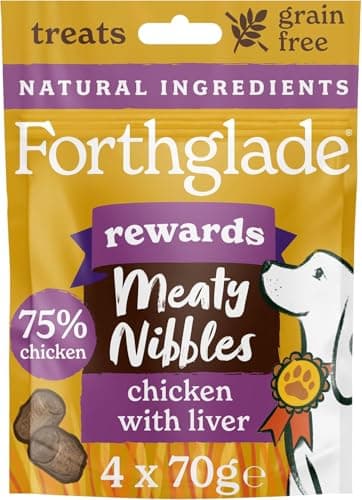
Best calorie-documented option: Forthglade Chicken with Liver Meaty Nibbles — 75% chicken and liver, 360 kcal/100g and labelled for all life stages; weigh the session portion because the maker does not publish a uniform per-piece calorie.
Best simple-recipe variety to compare: JR Pure Meat Training Treats Variety Pack 3 × 85g — separate chicken, duck and rabbit pouches, each described as 100% of the named meat and suitable from four weeks; introduce one pouch at a time.
Lowest-friction option: use part of the puppy's normal measured complete food for routine repetitions, reserving a separate treat for situations where higher reward value is genuinely needed.
Puppy treat comparison: what the makers currently publish
The table separates verifiable label facts from claims this site has not tested.
Exact option
Published age
Recipe / energy
Main decision limit
Forthglade Chicken with Liver Meaty Nibbles
All life stages
60% chicken + 15% chicken liver; 360 kcal/100g
Mixed recipe; chicken is unsuitable where it is being excluded, and per-piece calories are not published
JR Pure Meat Training Treats Variety Pack 3 × 85g
4 weeks+
Separate 100% chicken, duck and rabbit pouches; no kcal figure on current page
A three-protein pack is unsuitable for a controlled single-protein or elimination trial
Measured complete puppy food
Use the food's own life-stage guide
Already included in the daily ration
May be too low-value for every training environment; keep the daily ration balanced
What actually matters here
An exact minimum-age or life-stage statement on the current packet or maker page.
A complete composition and analytical-constituents panel for the exact flavour.
Published calories, or a manufacturer contact route when calories are absent.
A portion that can be measured and offered in an appropriate size and shape.
Compatibility with the puppy's complete food and any veterinary-prescribed diet or suspected reaction.
Who this is for
Owners planning frequent reward-based training who need a measurable session allowance.
People comparing one calorie-documented mixed recipe with separately packaged single-meat options.
Puppies whose age, diet and health fit the exact current packet instructions.
Who should skip
Puppies with diarrhoea, vomiting, reduced appetite, lethargy or suspected ingestion until the veterinary practice has advised.
A puppy on a prescribed diet or an elimination trial unless the veterinary team approves the exact treat.
Anyone relying on “natural”, “grain-free”, “hypoallergenic” or “calming” language as proof of tolerance or a health effect.
Use the daily ration before adding a second food
Put the puppy's measured complete food into a daily container and use part of it for easy training repetitions. This keeps those rewards inside the planned diet and makes it obvious how much remains for meals.
A separate treat can be useful when the environment is more distracting or the behaviour is especially important. Introduce one exact recipe at a time, keep the packet and note the amount offered. Do not assume that a short ingredient list, “natural” label or high meat percentage guarantees tolerance.
The 10% ceiling is a limit, not a puppy prescription
WSAVA's example calorie table is explicitly based on average healthy adult dogs in ideal body condition, so this page does not copy those numbers onto a growing puppy. Ask the veterinary team for the individual puppy's daily energy plan when accuracy matters, then weigh a treat where the maker gives only kcal/100g.
Ingredients and “single protein” need exact reading
Forthglade's published recipe is 75% chicken and liver, not a single ingredient. JR's three pouches each use one named meat, but opening all three at once introduces three proteins. A one-meat commercial treat is still not automatically suitable for a diagnosed allergy or a prescribed elimination diet.
WSAVA lists chocolate, macadamia nuts, allium vegetables, grapes and dried grapes, xylitol, alcohol, raw yeast dough and caffeinated drinks as unsafe. It also advises avoiding bones, excessively hard chews and unprocessed raw animal-based treats. Product age wording does not remove choking, contamination or dietary risk.
Urgent warning signs include blood or mucus, severe watery diarrhoea, vomiting, reduced appetite, lethargy or abdominal pain. Stop the new treat, retain its packaging and tell the veterinary team the exact recipe, amount and timing. A reaction does not prove which ingredient caused it.
Quick questions before you buy
What is the best puppy treat for training?
Start with part of the measured complete puppy food. If a higher-value reward is needed, choose an exact treat whose age, recipe, energy information and portion fit the puppy. This research-led shortlist compares Forthglade Meaty Nibbles and JR Pure Meat Training Treats; neither is proven best for every puppy.
How many treats can a puppy have?
There is no universal piece count because puppy requirements and treat sizes vary. WSAVA says treats should stay below 10% of daily calories, but its example table is for adults. Ask the veterinary team for the puppy's energy plan and measure the actual treat portion.
Published calorie density and an all-life-stages label
The maker does not publish a uniform calorie count per piece. It is a mixed recipe containing chicken, potato, glycerin, whey and minerals, so it is not a single-ingredient option or suitable when chicken is being excluded.
The current maker page does not publish calorie density, and a variety pack is the wrong format for a veterinary elimination trial. JR's “hypoallergenic” and digestibility language is a manufacturer claim, not a DPR finding.
££
Recommended picks
Top pick
Best for: Published calorie density and an all-life-stages label
Forthglade Chicken with Liver Meaty Nibbles£
Why it made the list: Forthglade publishes 60% chicken, 15% chicken liver, the remaining ingredients, full analytical constituents, 360 kcal/100g and an all-life-stages label. The pieces are described as easy to break, so a measured session portion can be subdivided.
Main drawback: The maker does not publish a uniform calorie count per piece. It is a mixed recipe containing chicken, potato, glycerin, whey and minerals, so it is not a single-ingredient option or suitable when chicken is being excluded.
JR Pet Products JR Pure Meat Training Treats Variety Pack 3 × 85g — separately packaged named-meat training pieces
Best for: Separately packaged named-meat training pieces
JR Pet Products JR Pure Meat Training Treats Variety Pack 3 × 85g££
Why it made the list: JR publishes three separate pouches—100% chicken, 100% duck and 100% rabbit—with analytical constituents for each and a four-weeks-plus age statement. Separate pouches make it possible to introduce one recipe before opening the next.
Main drawback: The current maker page does not publish calorie density, and a variety pack is the wrong format for a veterinary elimination trial. JR's “hypoallergenic” and digestibility language is a manufacturer claim, not a DPR finding.
The first-week checklist before optional purchases.
FAQ
What is the best puppy treat for training?
Start with part of the measured complete puppy food. If a higher-value reward is needed, choose an exact treat whose age, recipe, energy information and portion fit the puppy. This research-led shortlist compares Forthglade Meaty Nibbles and JR Pure Meat Training Treats; neither is proven best for every puppy.
How many treats can a puppy have?
There is no universal piece count because puppy requirements and treat sizes vary. WSAVA says treats should stay below 10% of daily calories, but its example table is for adults. Ask the veterinary team for the puppy's energy plan and measure the actual treat portion.
Can I use puppy food as training treats?
Yes. Set aside part of the measured complete-food ration for training and feed the remainder as meals. This avoids adding another recipe and helps keep the daily amount visible.
Are grain-free or single-meat treats safer?
Not automatically. Grain-free does not prove lower calories or better tolerance. A single-meat pouch can simplify ingredient tracking, but it is not a diagnosis or a substitute for a veterinary elimination diet.
What should I do if treats give my puppy diarrhoea?
Stop the new treat and contact the veterinary practice for advice because PDSA says diarrhoea can be more serious in puppies. Seek prompt help for blood, severe watery diarrhoea, vomiting, reduced appetite, lethargy or abdominal pain.
Can a four-week-old puppy have JR training treats?
JR labels this range for puppies from four weeks, but that manufacturer age statement does not decide weaning, diet, portion or medical suitability for an individual puppy. Ask the vet or responsible breeder when the puppy is not yet fully weaned or has any health concern.
Top pickForthglade Chicken with Liver Meaty Nibbles